
Scaling Future with Innovation
6. When the World Arrives in 2030, It Will Look Up
Yvonne Winter · CEO, FlyNow · September 22, 2026
Download PDF
Three things happened in Riyadh this month. Read apart, they are news. Read together, they are a conclusion.
- Riyadh signed the first private-sector joint venture of Expo 2030.
- The Ministry of Interior gathered more than 160 voices to ask what a century of security bought this country.
- And the conversation around Advanced Air Mobility in the Kingdom stopped being about ambition and started being about certification.
Here is why they belong in the same paragraph but made easy on the eyes with three notable bullets.
We Are Building a Neighborhood and a Community
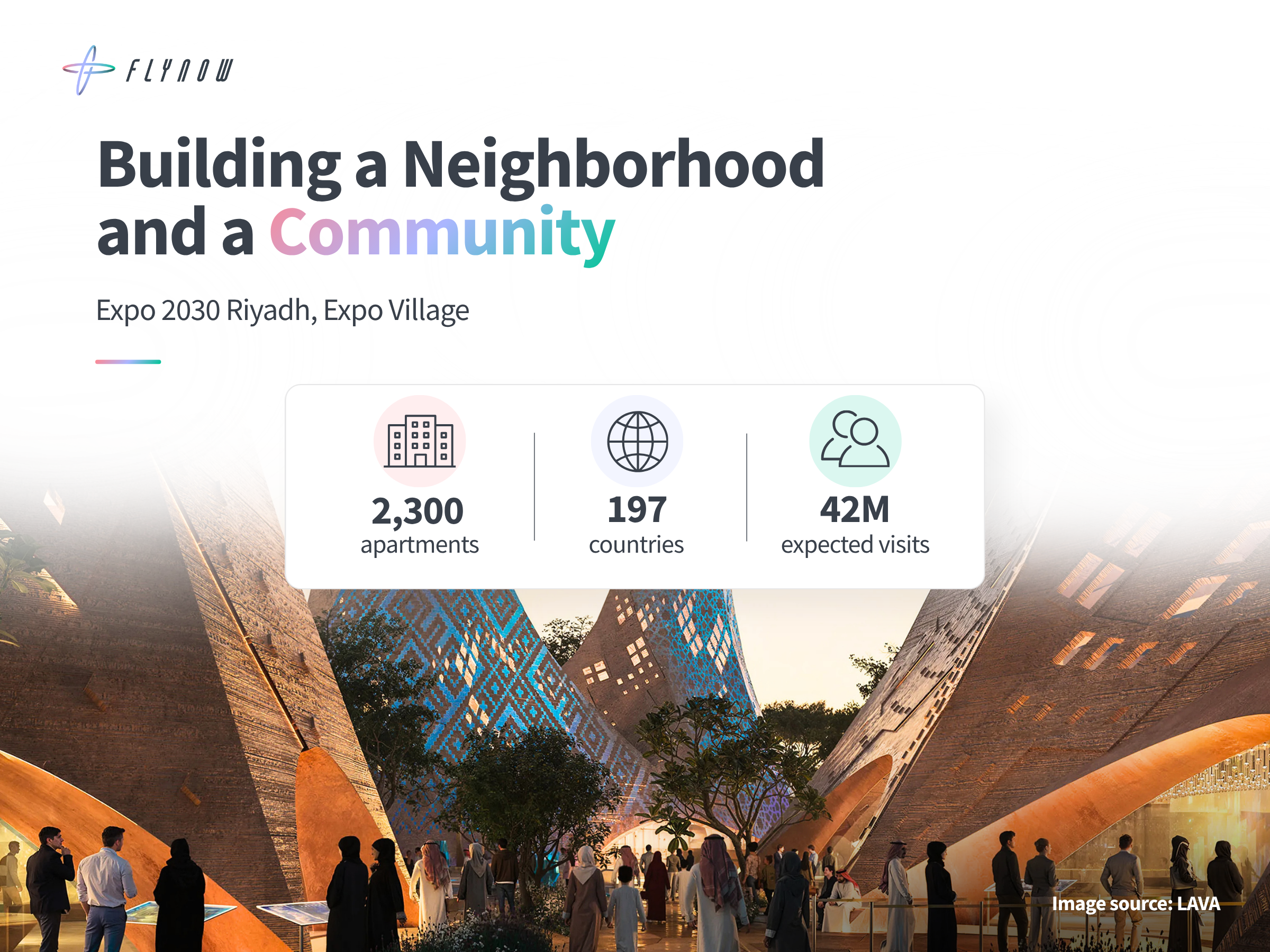
Expo 2030 Riyadh and Mohammad Al Habib Real Estate Company (MAHR) have signed a SR 3.2 billion ($853 million) joint venture to deliver the Expo Village: around 2,300 apartments for some 5,500 delegates, with retail, services, and a metro link to the 6-million-square-metre Expo site in north-west Riyadh. From 1 October 2030 to 31 March 2031, 197 countries will gather for an expected 42 million visits, under the theme “Foresight for Tomorrow:”
- Transformational technology
- Sustainable solutions
- Prosperous people.
The economics are substantial: PIF projects roughly $64 billion added to GDP across development and build-out, around 171,000 direct and indirect jobs, and a further $5.6 billion a year once the gates open. Through the “One Nation, One Pavilion” model, every country gets its own platform - with Saudi hospitality as the first and last thing a visitor remembers.
But the number that matters is not in that paragraph. It is the word first: the first joint venture of its kind for Expo 2030, private capital taking delivery risk alongside the state. And the Village does not come down when the flags do. It becomes a permanent residential district. The infrastructure endures. The investment compounds. Four years later, the World Cup will arrive. Expo is the steppingstone and the world will be watching whether we built for the moment, or for the people who live here afterwards.
Why You Can Walk Riyadh at Midnight - and What It Costs to Keep
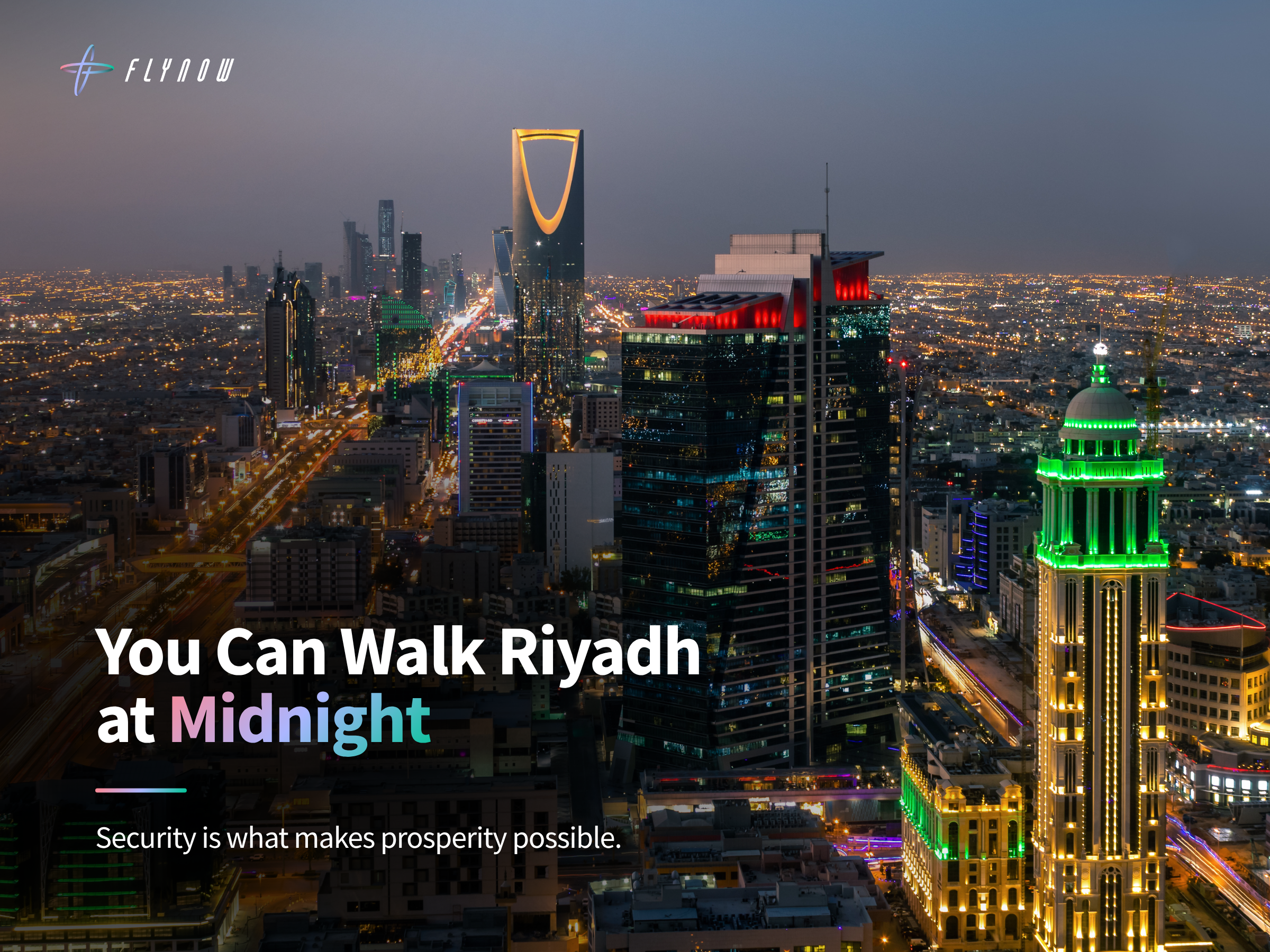
Earlier this month, the Security and History Dialogue 2026 brought more than 160 historians, researchers and specialists to the Cultural Palace in Riyadh’s Diplomatic Quarter, under the patronage of the Minister of Interior, HRH Prince Abdulaziz bin Saud bin Naif bin Abdulaziz Al Saud, under a theme that reads like a thesis: Our History and Our Future: Security and Prosperity. تاريخنا ومستقبلنا.. أمن ونماء
Sit in those sessions and one thing becomes hard to unhear. Everything this country has built; it built behind a wall somebody else was holding.
Anyone living here feels this without naming it. You walk home at night and think about nothing at all. That is not luck. That is a century of institutional discipline, compounding quietly. The Kingdom’s first firefighting brigade was formed in Makkah in 1927, men with hand pumps deciding that a city was worth protecting. Every generation inherits that decision and pays it forward on whatever the era is made of. Theirs was made of timber and rope. Ours is partly made of data.
So that discipline now must travel into new domains. As mobility lifts off the road and into three-dimensional airspace (drones, air taxis, and automated cargo sharing one sky) the Kingdom’s position is clear: sovereignty does not mean isolation. Saudi Arabia welcomes the world’s best technologists. But the architecture, the governance, the operational authority, and the critical data remain under Saudi control. Innovation flows in. Dependency does not.
Because a nation that does not control the data running its mobility systems does not really control those systems at all. Here you find a link to my speech and panel at the conference: https://www.youtube.com/watch?v=xlSqPSjcMc8 https://www.youtube.com/watch?v=EfVtMnv62h0
The Minutes We Hand Back to People
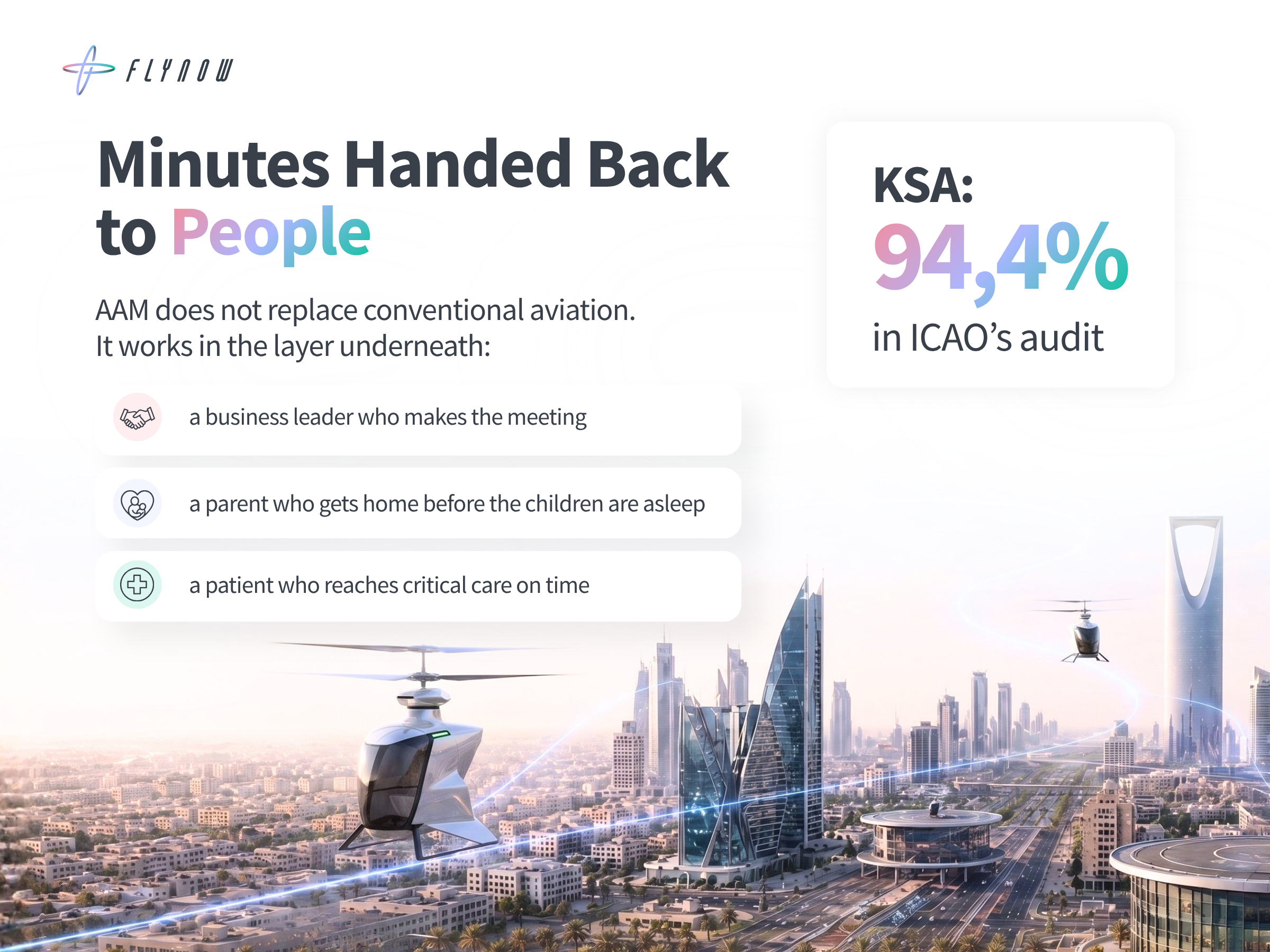
The Kingdom already holds one of the strongest aviation oversight records in the world: 94.4% in ICAO’s audit, seventh among G20 states. That is not a credential to hang on a wall. It is a governance culture built over decades of unglamorous work and it is the bedrock Advanced Air Mobility must grow on.
AAM does not replace conventional aviation. It works in the layer underneath, where people live. Every minute reclaimed between an airport, a mega-event venue, and an economic zone is a minute handed back: to a business leader who makes the meeting, to a parent who gets home before the children are asleep, to a patient who reaches critical care inside the hour that decides everything after. That is the product. The rest is engineering.
What looks like disadvantage here is an advantage nobody else can copy. Extreme heat and dust make this the hardest proving ground on earth for sensor reliability and thermal management — pass here, and you pass anywhere. Cybersecurity pressure becomes a reason to build sovereign, quantum-ready protocols. The need to earn community trust drives transparent acoustic monitoring and corridors routed with respect for the neighborhoods beneath them - trust earned on evidence, not on promises.
The Decade We Think We Have
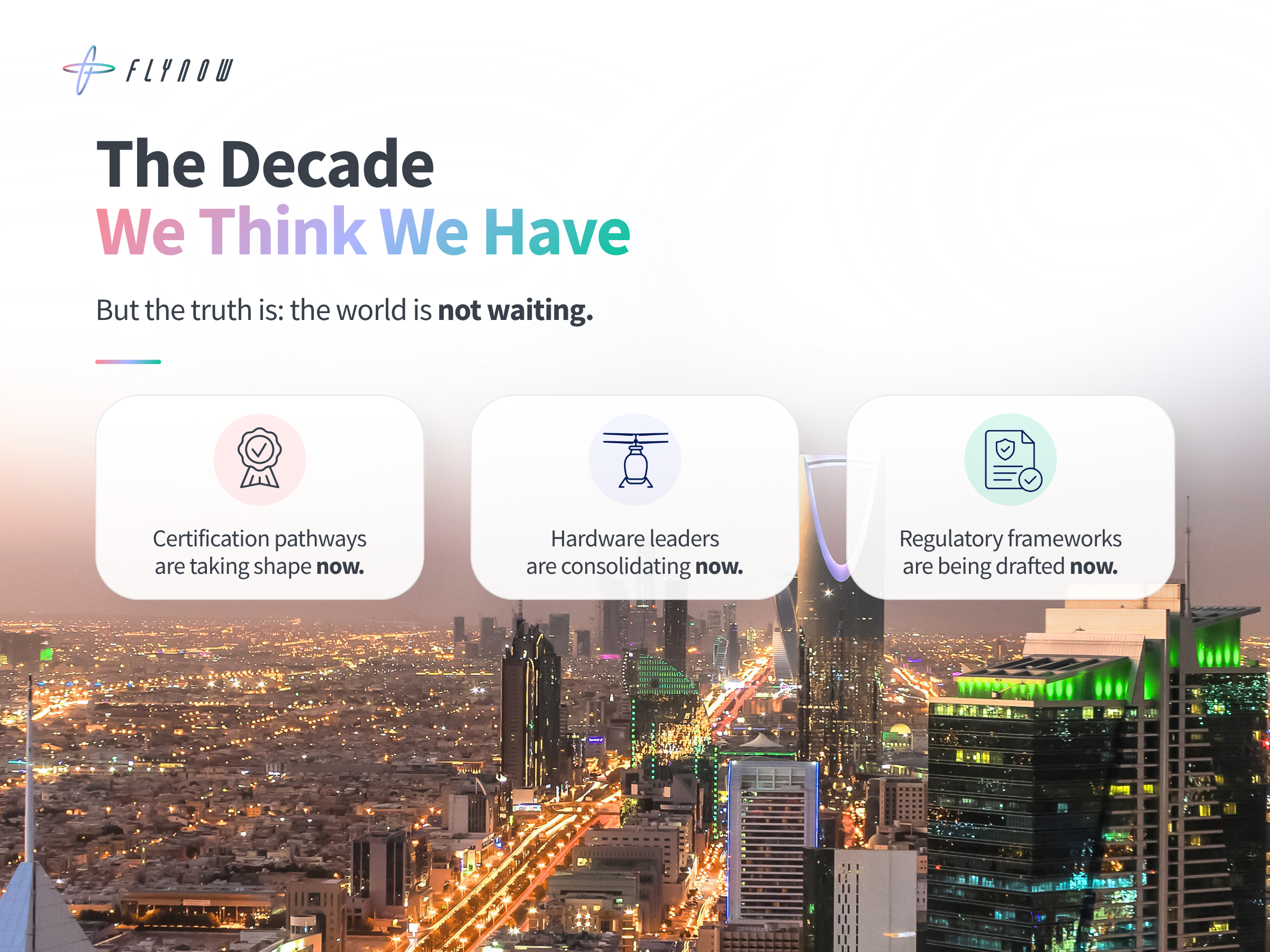
There is a comfortable belief that we still have ten years to deliberate. The caution is honest. Battery energy density improves incrementally. Sensor validation in this climate takes time. Certification timelines are demanding, and they should be.
But the world is not waiting. Certification pathways are taking shape across multiple jurisdictions. Hardware leaders are consolidating. Regulatory frameworks are being drafted in rooms we are not sitting in. Cities across Asia, Europe, and the Americas are positioning as early adopters. Every month that passes without a sovereign Saudi framework is a month in which somebody else sets the standard - a standard the Kingdom would then inherit rather than shape.
The choice was never caution versus speed. It is authorship versus adoption. And we have the safety culture, the institutional credibility, and the national ambition to hold the pen.
Learning From Everyone. Answering to Ourselves.
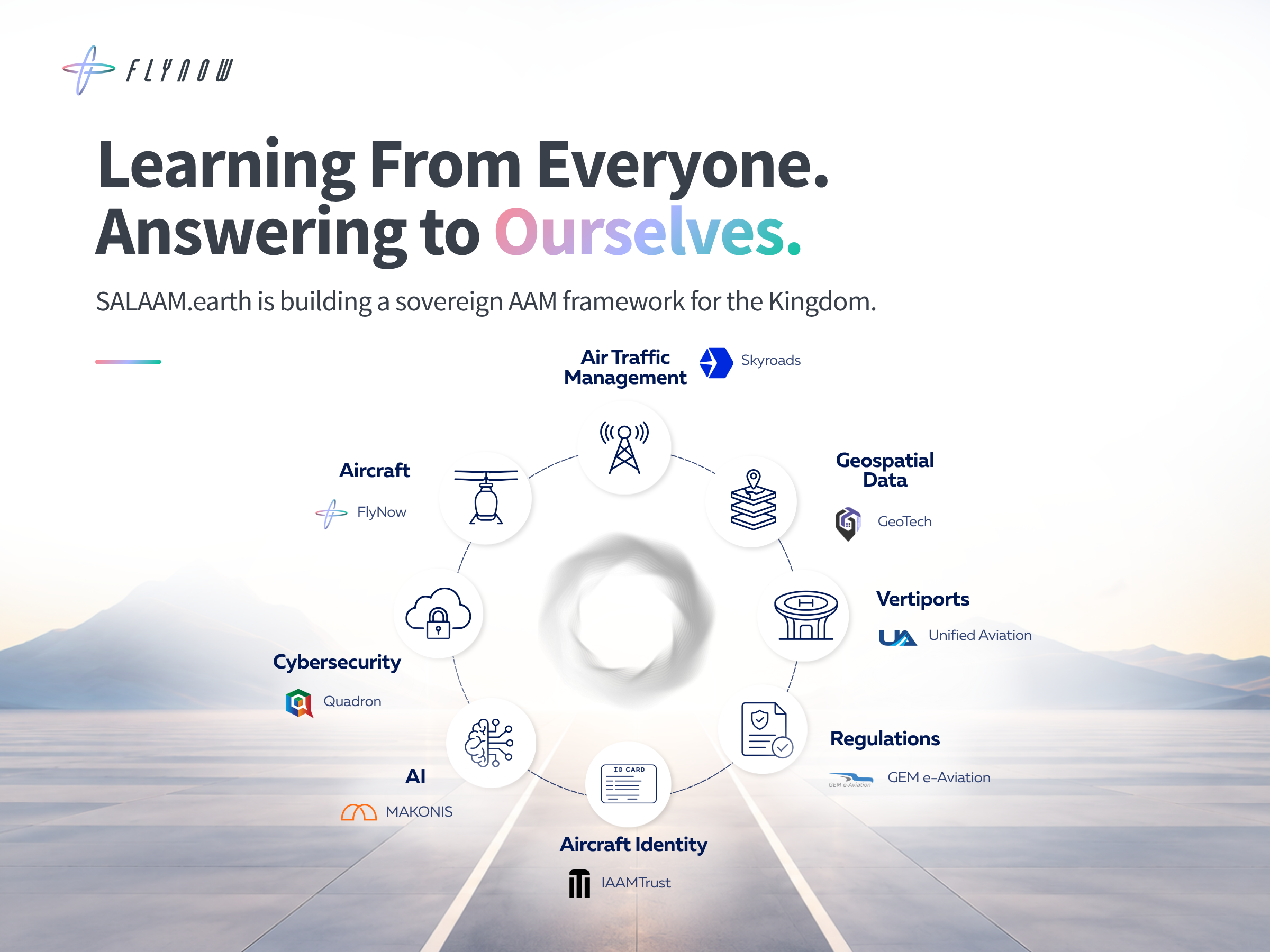
Writing the rules for a technology with no precedent is slow, serious, foundational work. It demands rigor, international interoperability, and real scar tissue. That is why the SALAAM alliance has established a technical advisory partnership with Austro Control, Austria’s air navigation service provider, which also carries the country’s delegated civil aviation agency functions.
Let me be precise. It is not a shortcut, and not an attempt to route around EASA or ICAO. It is a deliberate decision to build Saudi Arabia’s sovereign AAM framework with a hand on our shoulder that has already walked the European certification path - peer review, technical honesty, and the lessons that only come from the most demanding regulatory environments anywhere.
The result is a Saudi framework informed by global best practice, robust enough to meet international norms, interoperable with the standards emerging in Europe - and entirely under Saudi authority. This is how serious nations build a new transport category. Not by copying. By learning from the best, then writing their own.
It is the same reason we founded SALAAM, the Sky Alliance for Automated Air Mobility, in 2024 as a non-profit: so that no single company owns the framework. A real sandbox does not prove that one aircraft can fly from A to B. It proves an ecosystem holds - aircraft talking to infrastructure, infrastructure to traffic management, emergency services receiving exactly what they need, and the regulator in command of the airspace at every moment.
The sandbox produces documented, recorded evidence for a technology that has no history yet. We are writing the archive in advance and we are writing it here in the Kingdom.
One Window - and It Is Already Closing
- Expo 2030.
- The World Cup 2034.
- A sovereign infrastructure doctrine.
- A world-class aviation safety culture.
- A European advisory partnership that puts international credibility in place from day one.
They are one window, not five separate initiatives - and windows do not stay open out of courtesy.
Saudi Arabia does not need to inherit anyone else’s definition of urban mobility. It has the institutional strength, the national will, and the safety culture to write its own. The question was never whether this future arrives. It is whether we are the nation that shaped it - or the one that adapted to somebody else’s.
When the world arrives, it will not ask how quickly we moved. It will ask whether we had the courage to build something that outlasts us.
I believe that courage is already here in the Kingdom of Saudi Arabia.
Happy National Day! Wishing you and your family Joy, Pride, and Prosperity.