
Scaling Future with Innovation
7. Is the eCopter a helicopter or an eVTOL?
Yvonne Winter · CEO, FlyNow · September 29, 2026
Download PDF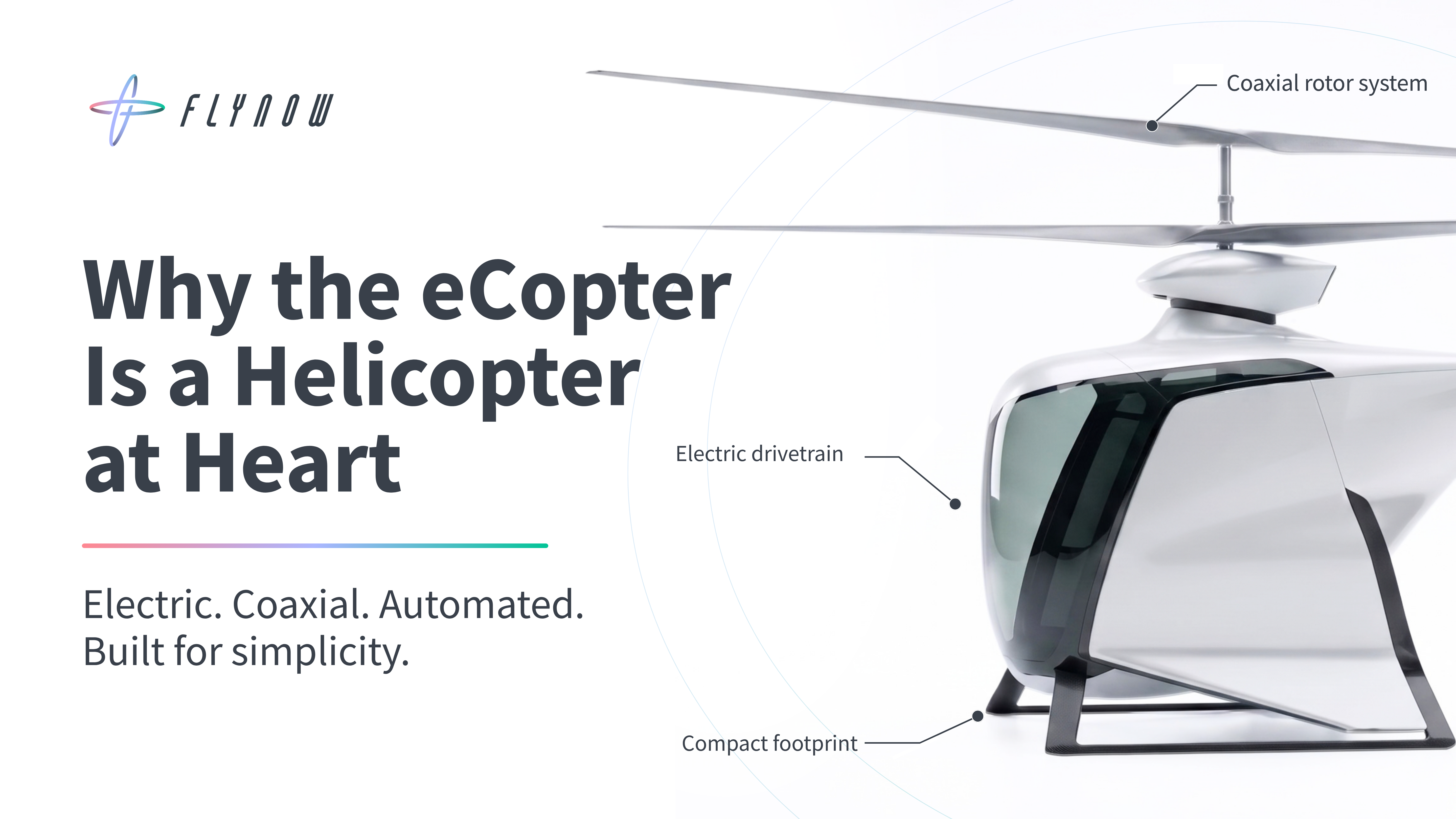
Every time we set up our booth at a trade show or an event, the same conversation plays out within the first hour. Someone wanders over, looks the eCopter up and down, tilts their head a little and asks: "So… is this a helicopter or an eVTOL?" Usually followed by: "Why didn't you go for wings and a dozen rotors like everyone else?"
We never tire of that question. It cuts straight to the heart of what we're doing at FlyNow Aviation. So, we thought we'd finally put down in writing the answer we give at the booth — and lay our cards on the table about both the strengths and the trade-offs.
First, let's untangle the words
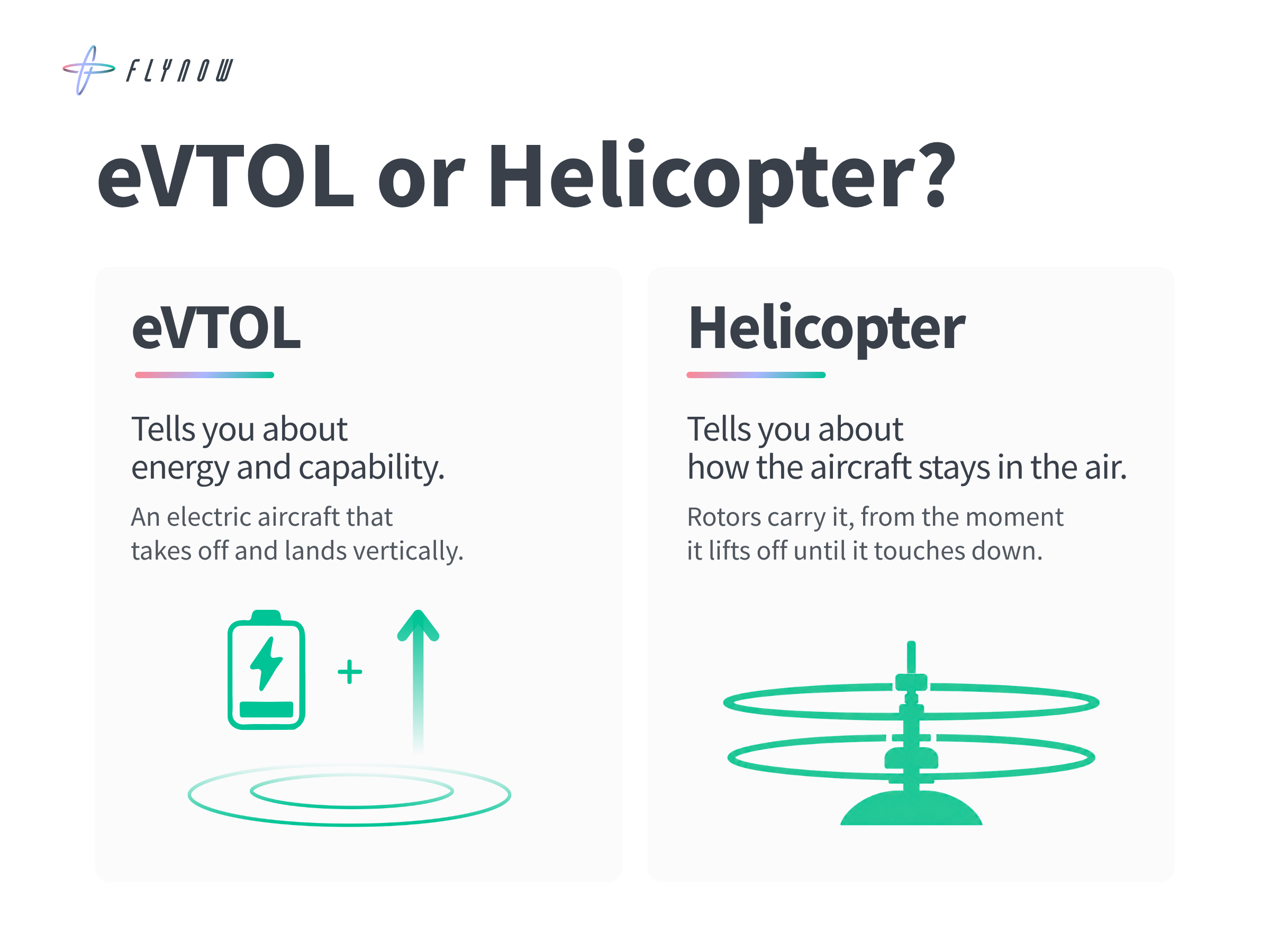
"eVTOL" and "helicopter" describe two different things, and that's where most of the confusion stems from.
- eVTOL tells you about energy and capability: an electric aircraft that takes off and lands vertically. It's an umbrella term.
- Helicopter tells you about how the aircraft stays in the air: rotors carry it, from the moment it lifts off until it touches down.
So yes, strictly speaking, the eCopter is an eVTOL. It runs on electricity, and it goes straight up and straight down. But in how it's built, how it flies and how it will be certified, it has far more in common with a helicopter than with the winged, multi-rotor air taxis most people picture when they hear "eVTOL."
Boiled down: the eCopter is a small, automated, electric coaxial helicopter. Two large rotors stacked on one mast, spinning in opposite directions. No tail rotor. No wings. No tilting nacelles.
Why we built it that way
Over the past ten years, the industry has poured billions into aircraft with 12, 16, even 36 electric motors, tilting wings and elaborate transition systems. Some of those programs have ground to a halt or fallen apart altogether, and a pattern runs through it: every extra motor brings extra weight, extra wiring, extra heat, extra software and extra paperwork. Complexity racks up costs in everything aviation cares about.
We set out from the opposite end. Instead of asking "what can we add?" we asked "what can we do away with?" Three things made the cut:
- Two counter-rotating rotors on one mast
- A pure electric drivetrain
- A tilting rotor head instead of a swashplate
Let me explain each of the above three further:
1. Two counter-rotating rotors on one mast.
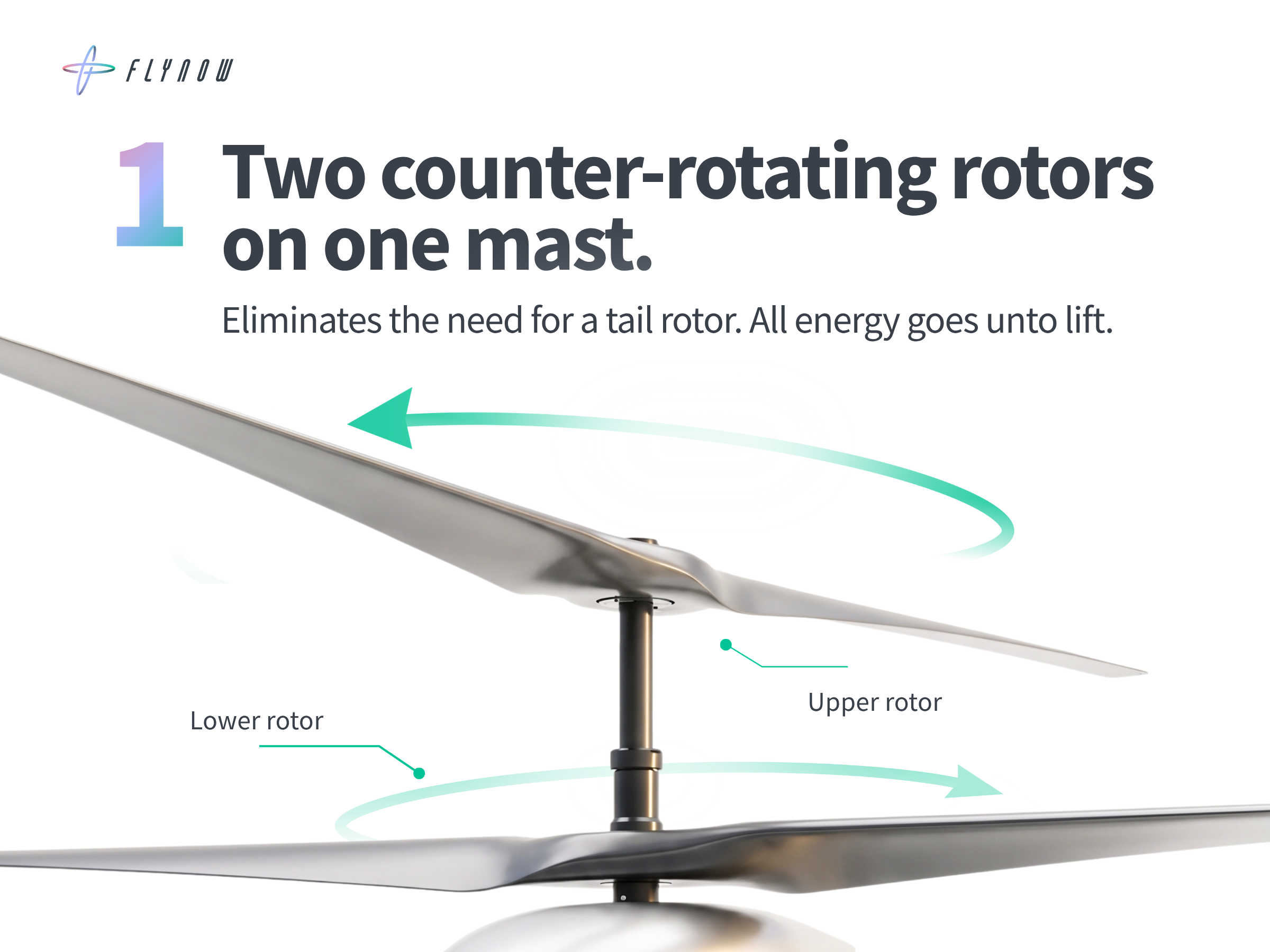
In a conventional helicopter, a good chunk of the engine's power is eaten up by the tail rotor just to stop the aircraft from spinning round. Stack two rotors turning in opposite directions and that problem cancels itself out. All the energy goes into lift.
2. A pure electric drivetrain.
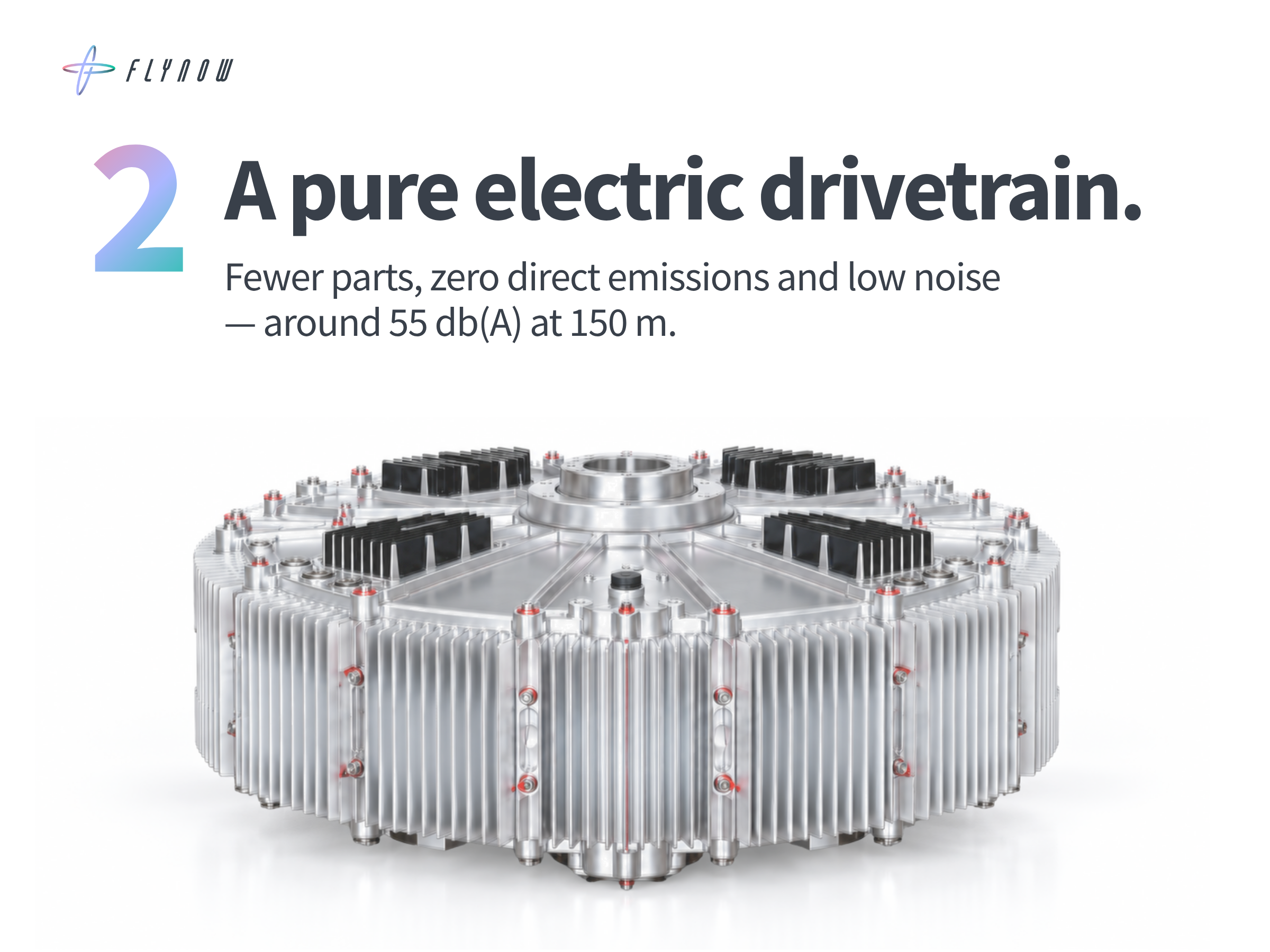
No turbine, no fuel system, no multi-stage gearbox. Fewer parts to wear out, instant torque, zero direct emissions, and a noise footprint around 55 dB(A) at 150 meters — roughly on a par with a normal conversation.
3. A tilting rotor head instead of a swashplate.
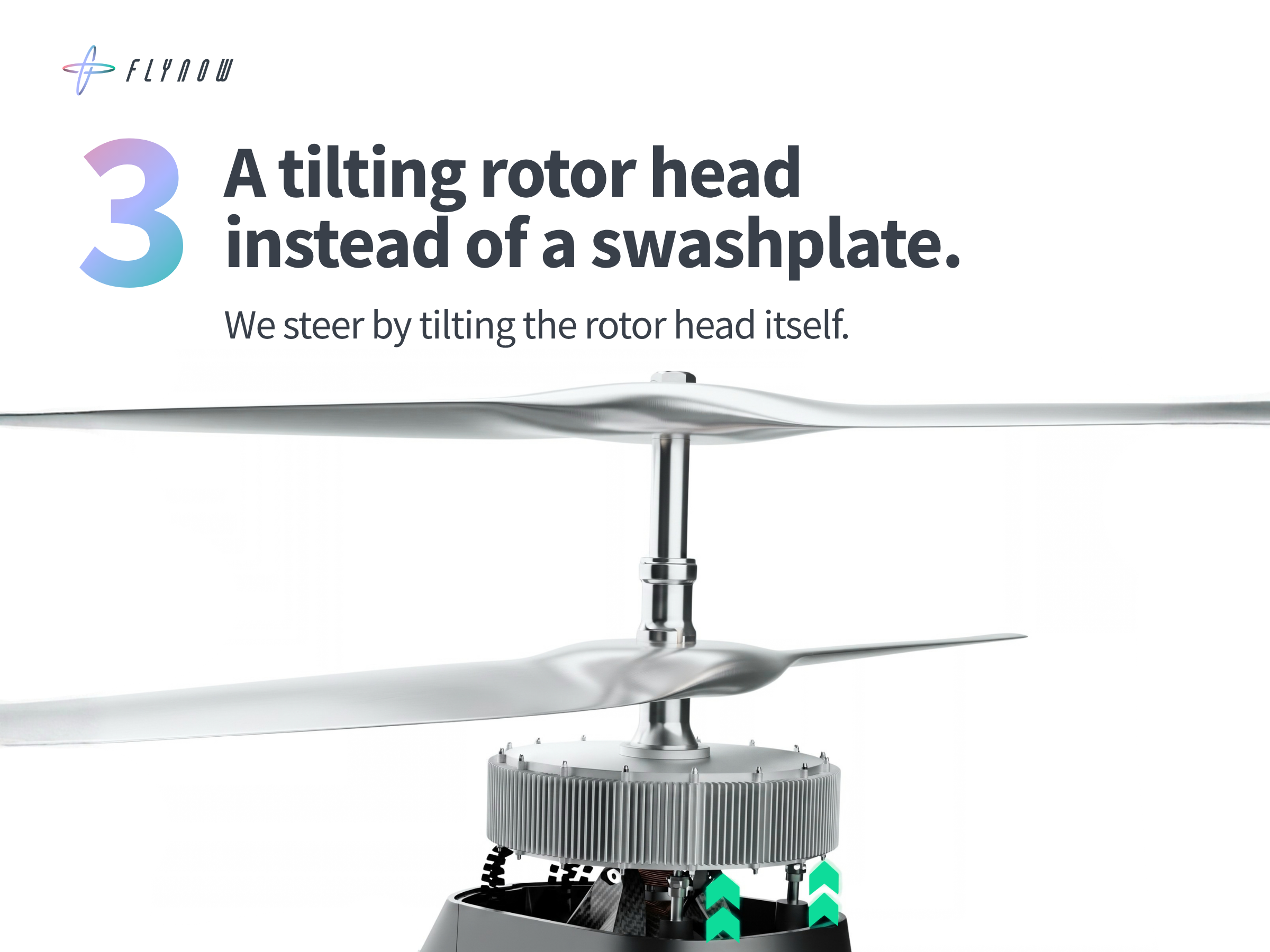
Conventional helicopters steer with a swashplate, a beautiful but intricate assembly with dozens of linkages that must be pored over at every inspection. We steer by tilting the rotor head itself. One clean mechanism standing in for many.
An old idea, a new take
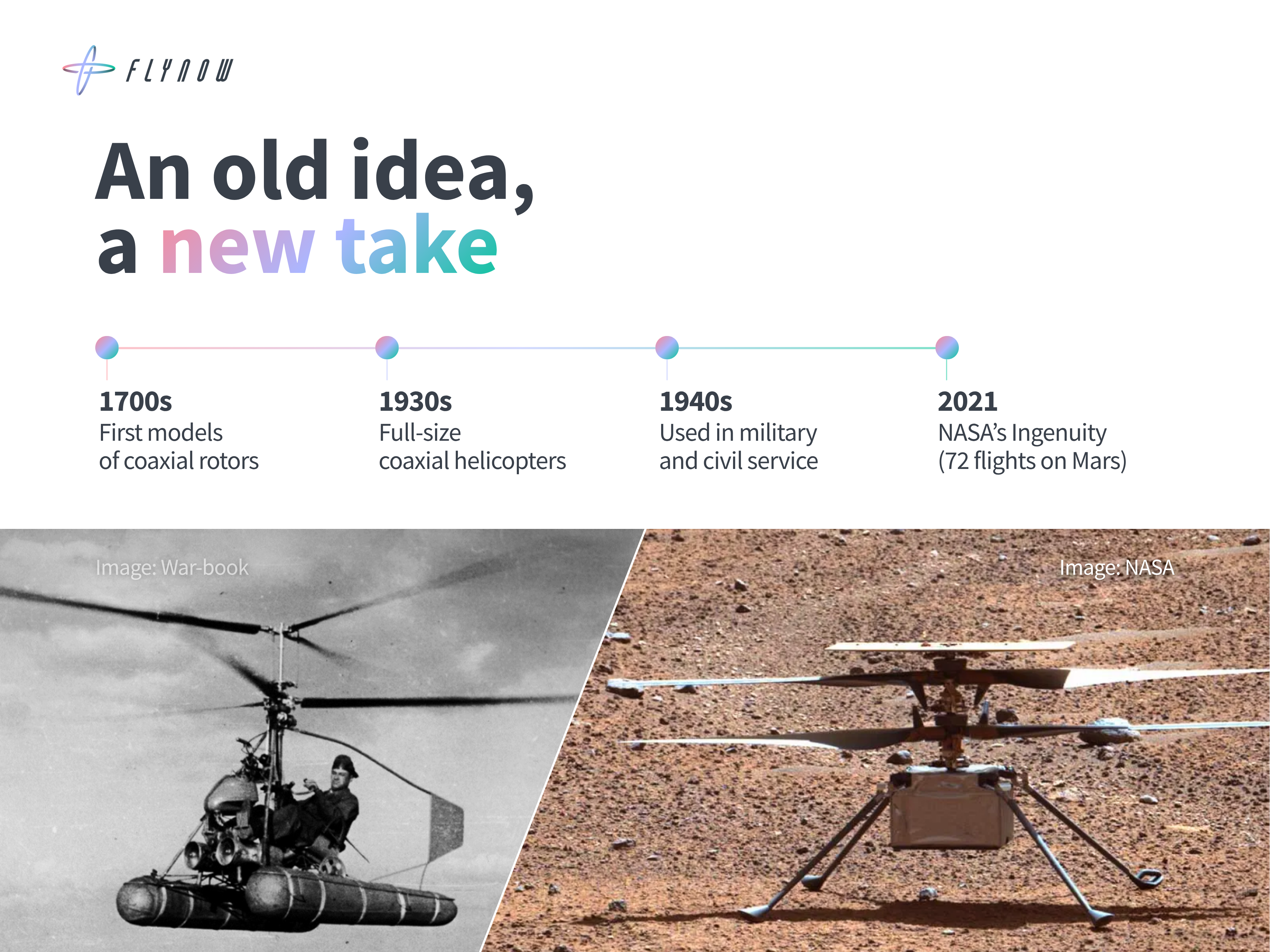
We make no claim to have invented the coaxial rotor. Nobody alive can. Models of it were flying in Russia and France in the 1700s, full-size coaxial helicopters were in the air by the 1930s, and one design bureau has been building them for military and civil service since the 1940s. It is one of the most thoroughly proven layouts in rotorcraft history.
What is ours is the combination. 15 years ago, long before electric flight was taken seriously, Jurgen Greil, sketched out a coaxial rotorcraft that swapped the swashplate for a tilting rotor head and the turbine for electric motors — a machine simple enough to be automated from the ground up. That sketch is the eCopter.
And in 2021, the layout got its ultimate stress test. When NASA needed a flying machine for Mars, where the air is about 1% as dense as ours and there is zero margin for error, they settled on coaxial counter-rotating rotors on an electric drive. Ingenuity was meant to fly five times. It flew 72. We take that as vindication — not of our originality, but of our judgement.
The authentic part: strengths and trade-offs
No aircraft is good at everything. Here's how we see it, warts and all.
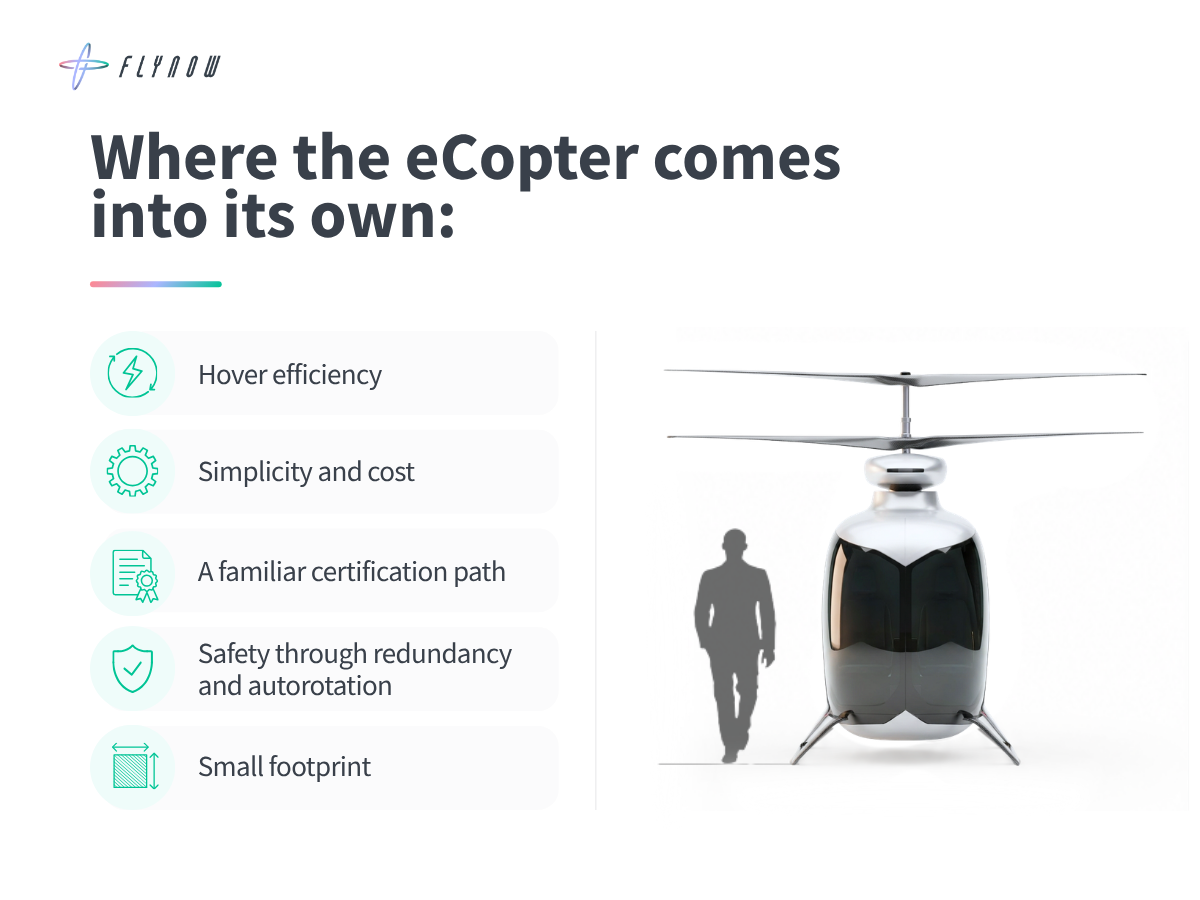
Where the eCopter comes into its own:
- Hover efficiency. Two big rotors move a lot of air slowly. That's far more efficient in hover than many small fans whirring away at high speed, and it counts for most in hot climates, where thin air punishes inefficient designs. For Gulf summers, this is no footnote.
- Simplicity and cost. Fewer parts mean less weight, less maintenance and lower production cost. That's what turns taxi-level fares from a pipe dream into a realistic target.
- A familiar certification path. Regulators drew up special frameworks like EASA's SC-VTOL because winged, distributed-propulsion aircraft didn't fit any existing rulebook. A rotorcraft with up to two main rotors already has one: CS-27. We still must work through the novel bits (electric propulsion, automation) but we're setting off from a known place rather than a blank page.
- Safety through redundancy and autorotation. This is a point that often slips under the radar. Like any helicopter, the eCopter can autorotate: if power is lost, the rotors keep turning from the airflow and the aircraft can be brought down in a controlled descent. That's why we don't carry a ballistic parachute. A parachute wouldn't make the eCopter any safer than autorotation already does; it would just weigh it down. So, we left it out.
- Small footprint. No wingspan, no outrigged rotor arms. It slots into tight urban sites, hospital pads and industrial
Where we've knowingly given ground:
- Speed. The eCopter cruises at around 115 km/h, which is where it's most efficient. It isn't trying to hit the 250–320 km/h of winged tiltrotors, and it never will.
- Range. Without a wing to carry it in cruise, the eCopter is designed for hops of up to about 50 km. Crossing a region city to city is not our mission. Frequent, short, repeatable routes are.
- Seats. One or two passengers, or a Euro pallet of cargo. The larger air taxis carry four plus a pilot. We opted for small and automated on purpose, but it does mean less revenue per flight on a busy route.
A new home in Riyadh
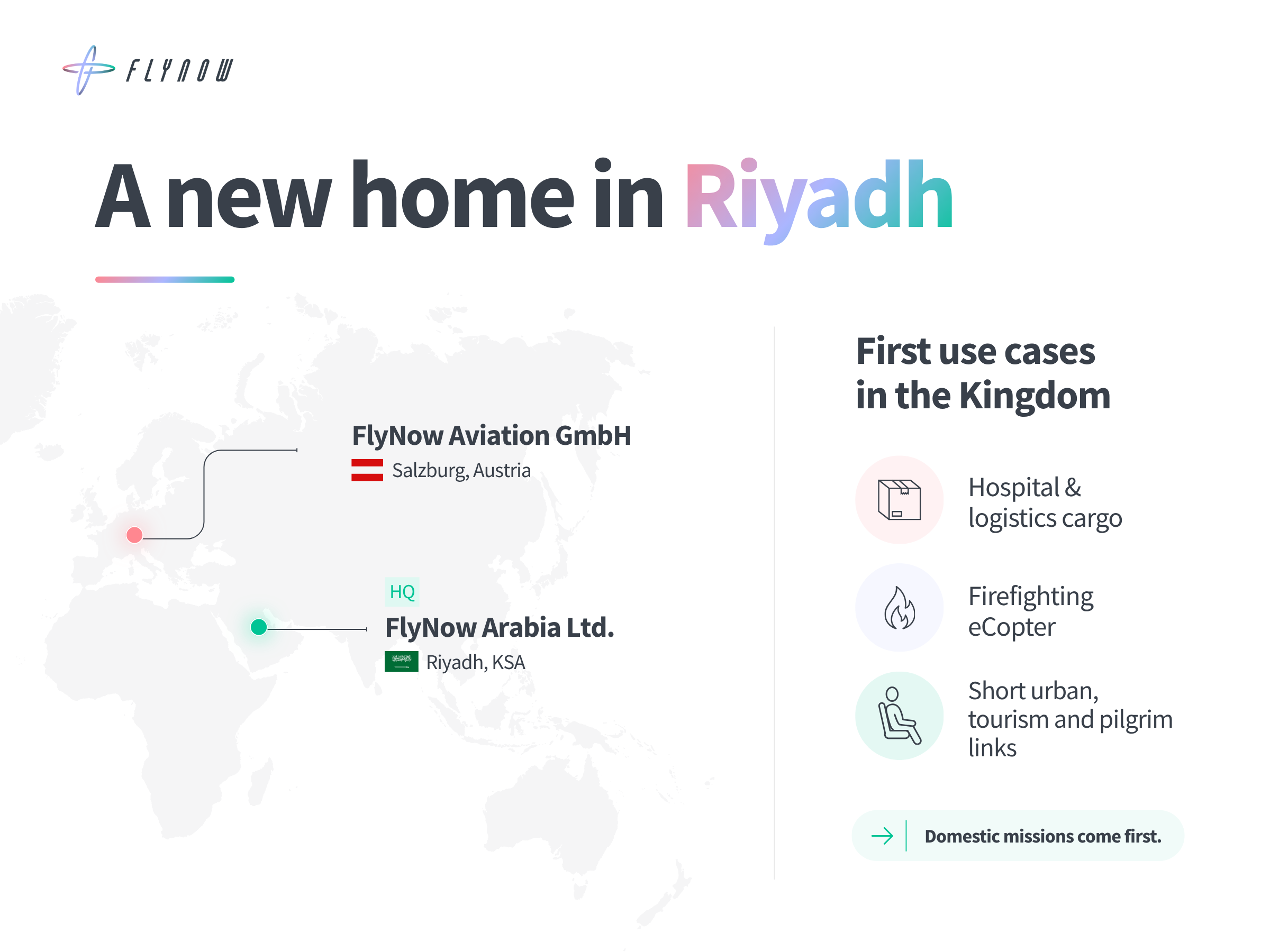
The other question we field at the booth these days is "where are you based now?" The answer has changed. FlyNow Aviation has moved its global headquarters to Riyadh. And our new name is Flynow Arabia.
This isn't a flag-planting exercise. It changes how we build and prove the aircraft. Alongside our test program in Austria, we're rolling out flight testing in Saudi Arabia, because if you want to know how an electric rotorcraft holds up in heat, dust and thin summer air, you test it where those conditions are real, not simulated. It also means the eCopter will be assembled here: our production plant is going up in the Kingdom.
Our order of priorities is deliberate. The Kingdom's own needs come first — hospital and logistics cargo, our firefighting eCopter for putting an automated aircraft over a blaze without putting a crew in harm's way, short urban links, tourism sites like Diriyah and AlUla, and pilgrim shuttles between the holy sites. Once those domestic missions are up and running, aircraft built in Saudi Arabia will be shipped out to the rest of the GCC and to the world.
Where that leaves us
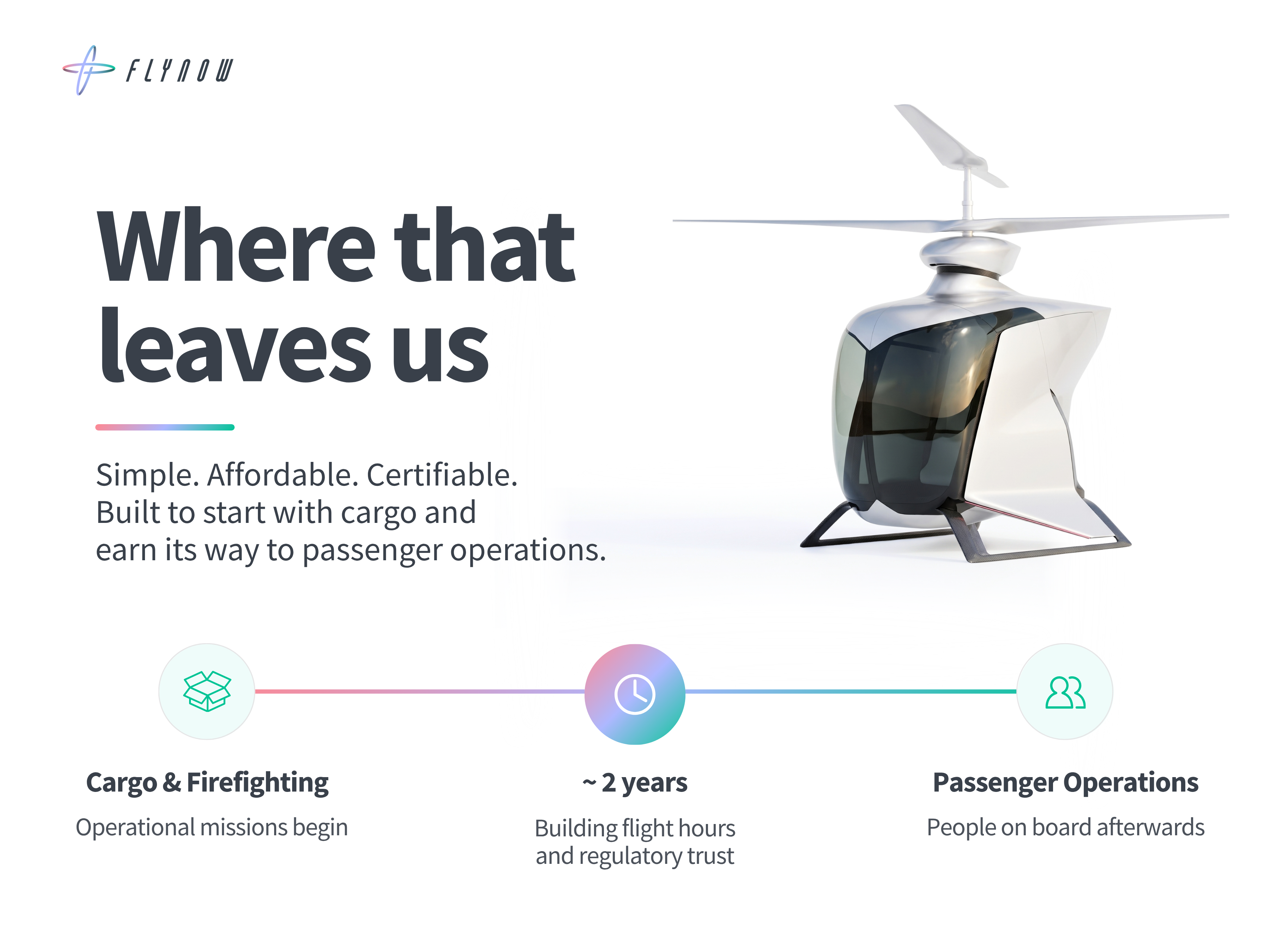
The eCopter isn't trying to outrun or outsize anyone. It's setting out to be the simplest, most affordable and most certifiable way to move people and goods short distances above a city.
We're kicking off with cargo, building up flight hours and regulatory trust, and only then carrying passengers. That's the slow road, but in aviation the slow road is usually the one that gets there.
So next time you drop by our booth and ask: "helicopter or eVTOL?", the answer is: both, technically. But at heart, it's a helicopter — one with everything unnecessary stripped away, and from now on, one made in Saudi Arabia.The result is a Saudi framework informed by global best practice, robust enough to meet international norms, interoperable with the standards emerging in Europe - and entirely under Saudi authority. This is how serious nations build a new transport category. Not by copying. By learning from the best, then writing their own.
If you've got a view on simplicity versus distributed propulsion, we'd genuinely like to hear it. Weigh in below.