
Scaling Future with Innovation
1. How to Create a Skyrocketing Business Case
Yvonne Winter · CEO, FlyNow
Download PDF
"The greatest businesses are not built by maximizing the profit per customer, but they are built by maximizing the value created for millions of customers."
When discussing disruptive technologies such as Advanced Air Mobility (AAM), many conversations still revolve around aircraft performance, battery technology, or certification. While these are essential, history teaches us that technological superiority alone rarely creates the largest businesses.
The world's most successful companies share four common characteristics:
- They target the mass market, not a luxury niche.
- They are designed for scalability from day one.
- They build platforms, not just products.
- They orchestrate ecosystems, not isolated businesses.
Let's explore why.
01Mass Market Beats Luxury
Luxury products can generate exceptional margins, but scale creates industries.
Take the automotive sector as an example.
Ferrari is one of the world's most profitable car manufacturers on a per-vehicle basis, earning approximately US$1.5 billion in annual net profit with industry-leading margins. Toyota, however, sells more than 10 million vehicles every year and generates roughly US$30 billion in annual net profit.
The lesson?
Margin per product is important. Total value creation is what matters.
The same principle applies to aviation.
Private aviation is prestigious but serves only a very small customer base. Commercial aviation, by contrast, transports billions of passengers annually and has created one of the world's largest economic ecosystems.
Advanced Air Mobility should learn from commercial aviation, not from private aviation.
Consider two simplified business models.
| Luxury Air Taxi Model | Mass-Market Automated Mobility |
|---|---|
| Fleet: 50 aircraft | Fleet: 10,000 aircraft |
| 10 flights per day | Fleet: 10,000 aircraft |
| Average fare: US$350 | Average fare: US$25 |
| 2 passengers per flight | 2 passengers per flight |
| Annual revenue: approximately US$127.8 million | Annual revenue: approximately US$3.65 billion |
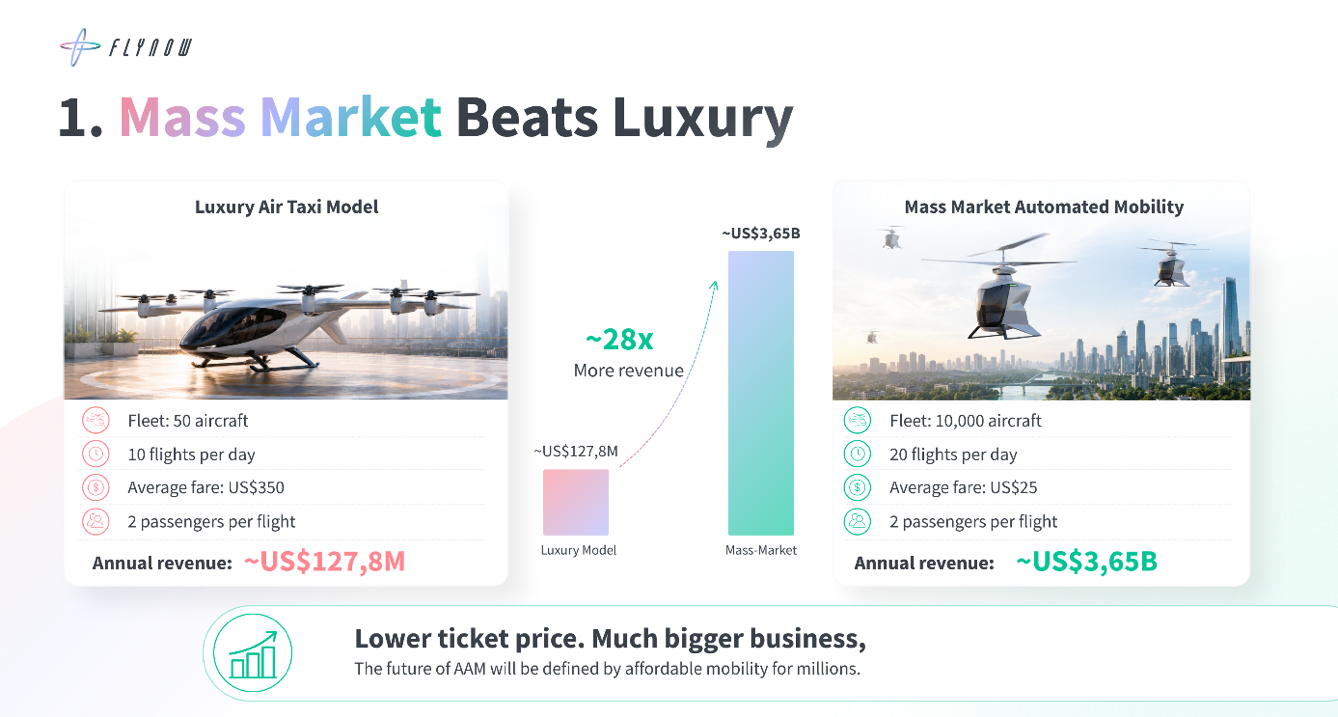
Although the ticket price is ten times lower, the business becomes around 28 times larger in revenue, simply because of scale and utilization.
The future of AAM will not be defined by premium transportation, it will be defined by affordable mobility for millions.
02Platforms Beat Standalone Products
The world's most valuable companies increasingly own platforms rather than products.
A striking example is Airbnb.
Although Marriott generates more than twice Airbnb's revenue, Airbnb earned US$2.65 billion in net profit in FY2024, compared with Marriott's US$2.38 billion.
Why?
Because Airbnb connects participants rather than owning the underlying assets.
Platforms scale faster than asset-heavy businesses.
The same logic applies to Advanced Air Mobility.
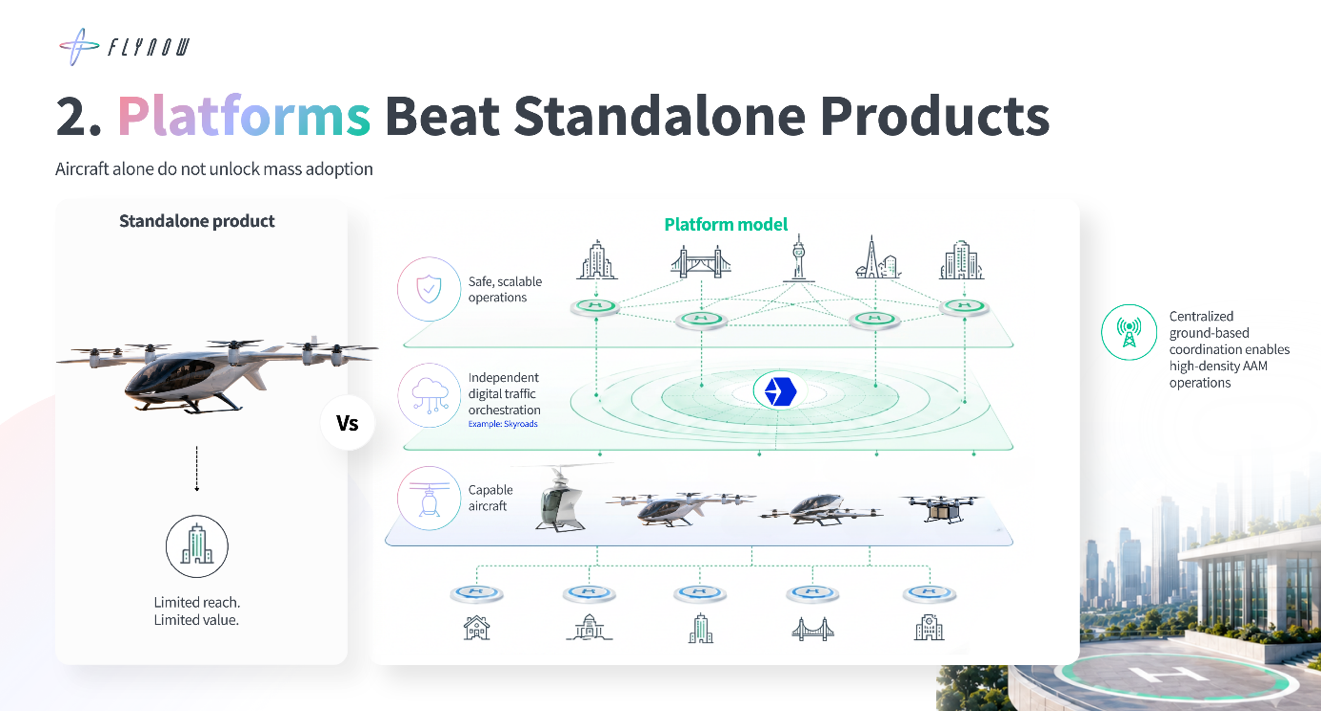
Aircraft alone will not unlock mass adoption.
Safe, highly automated operations require an independent digital layer that coordinates thousands of aircraft simultaneously.
This is precisely where Skyroads occupies a unique position.
Skyroads is an independent, manufacturer-agnostic, aviation-safety-grade Air Traffic Management platform. It represents the missing layer between capable aircraft and commercially viable, large-scale operations.
Independent research from Boeing has highlighted that airborne detect-and-avoid alone is insufficient for high-density AAM operations. Ground-based, centralized traffic orchestration is required.
That market opportunity belongs to platforms, not individual aircraft manufacturers.
03Ecosystems Beat Siloed Businesses
History repeatedly demonstrates that ecosystems outperform isolated businesses.
Apple did not become one of the world's most valuable companies because of the iPhone alone. Amazon is more than an online retailer. Uber is more than a taxi company.
Each company created an ecosystem where multiple participants generate value together.
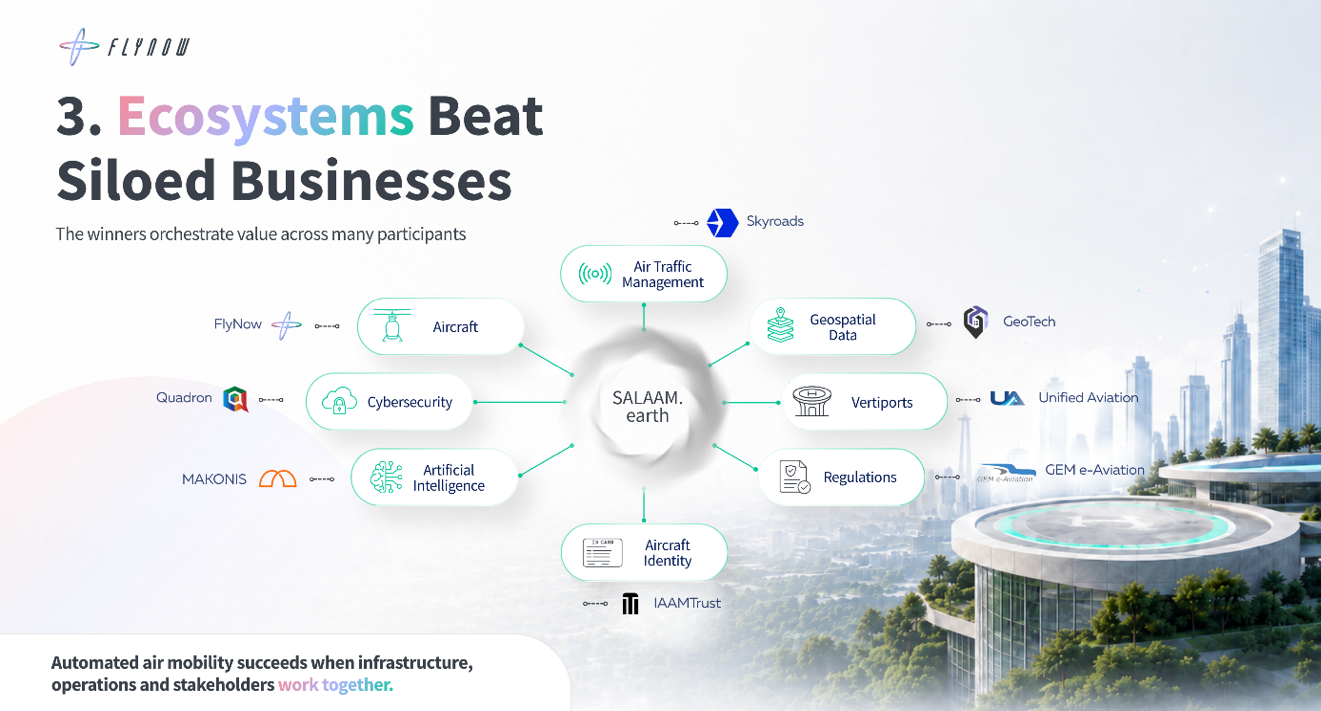
Ecosystems create:
- network effects
- higher customer lifetime value
- lower transaction costs
- faster innovation
- stronger competitive advantages
The same principle applies to Advanced Air Mobility.
Aircraft manufacturers, infrastructure providers, operators, regulators, energy providers, maintenance organizations, emergency services, public transportation, and digital services must all work together.
This is the vision behind SALAAM.earth.
Rather than being another aircraft company, SALAAM.earth acts as an Advanced Air Mobility Ecosystem Orchestrator, bringing together all stakeholders required to enable safe, scalable, and commercially successful automated air mobility.
04Scalability Creates Industries
Perhaps no historical example illustrates scalability better than Henry Ford.
Ford did not invent the automobile.
He reinvented how automobiles were produced.
By applying standardized production methods and assembly-line manufacturing, he reduced costs dramatically and transformed the automobile from a luxury product into everyday transportation.
The result was not merely a successful company, it was the birth of the modern automotive industry.
Advanced Air Mobility now faces a similar opportunity.
Most current eVTOL manufacturers still rely on aerospace production methods, producing only dozens of aircraft annually.
A typical manufacturer might produce 50 aircraft per year, generating around US$65 million in annual profit while requiring US$1.5–3.5 billion of investment before reaching series production.
FlyNow follows a fundamentally different approach.
By applying proven automotive manufacturing principles to aviation, FlyNow is designed for industrial-scale production.
Illustratively:
| Typical eVTOL Manufacturer • Production: 50 aircraft/year • Approximate annual profit incl. spare parts: US$65 million • Investment to series production: US$1.5–3.5 billion | FlyNow • Production: 10,000+ aircraft/year • Approximate profit per aircraft: US$150,000 • Additional spare parts and services: ~US$50,000 per aircraft • Potential annual profit: approximately US$2 billion • Investment to series production: less than US$500 million |
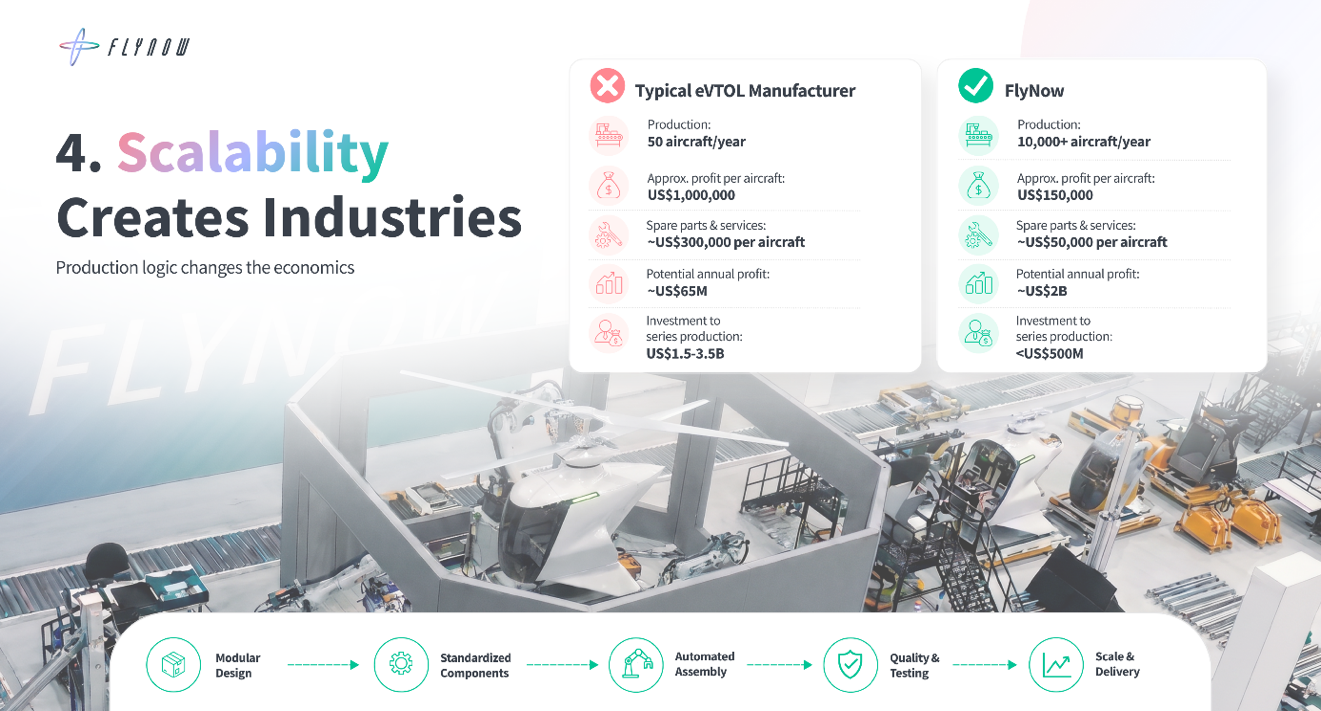
Scalability fundamentally changes the economics.
05Finally: Put the Customer at the Center
Every disruptive company ultimately succeeds for one reason:
It solves a real customer problem.
| People do not buy aircraft. | They buy mobility. |
| They do not buy platforms. | They buy convenience. |
| They do not buy ecosystems. | They buy better experiences. |
The businesses that transform industries always begin with the customer and then build scalable solutions around their needs.
The Formula for a Skyrocketing Business Case
The companies that redefine industries consistently follow the same blueprint:
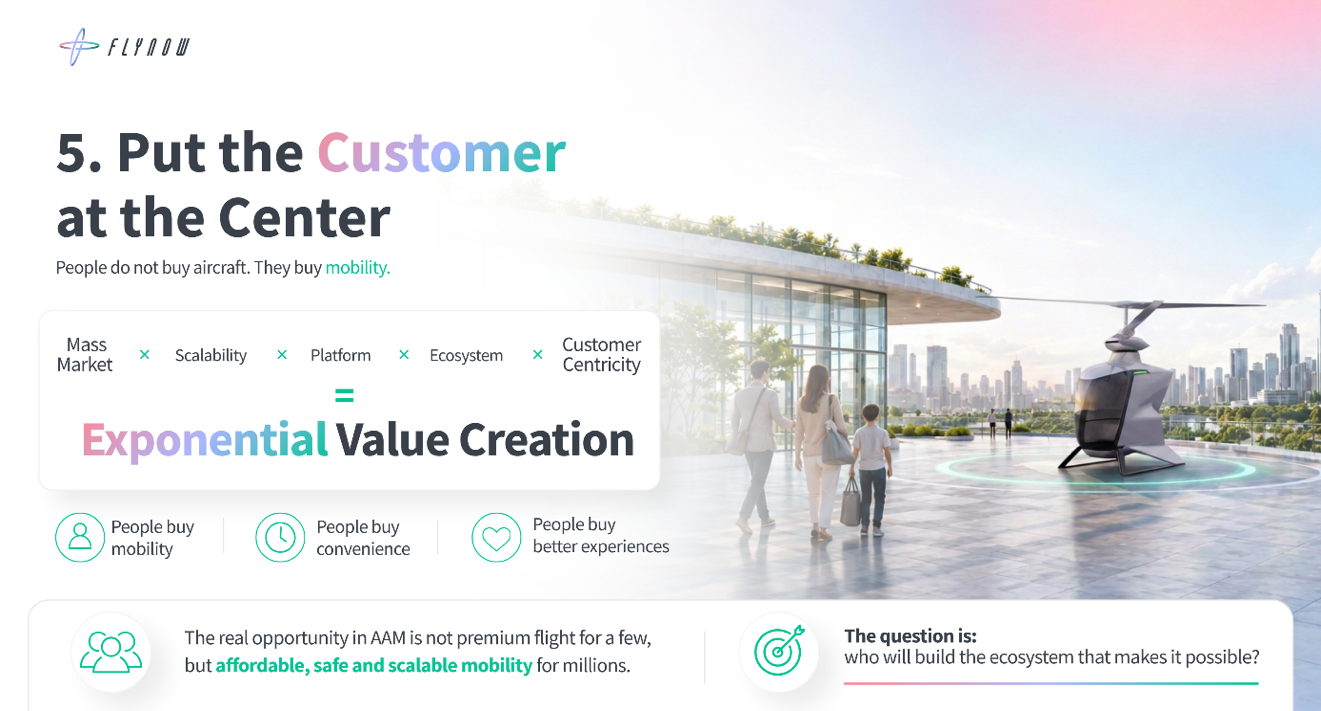
Advanced Air Mobility has the potential to become one of the defining industries of the coming decades.
The question is no longer whether the technology will work.
The real question is:
Who will build the ecosystem capable of bringing automated air mobility safely, affordably, and at scale to millions of people?