01We electrified the car. Nobody questioned the car.
Start by conceding the argument everyone expects us to fight.
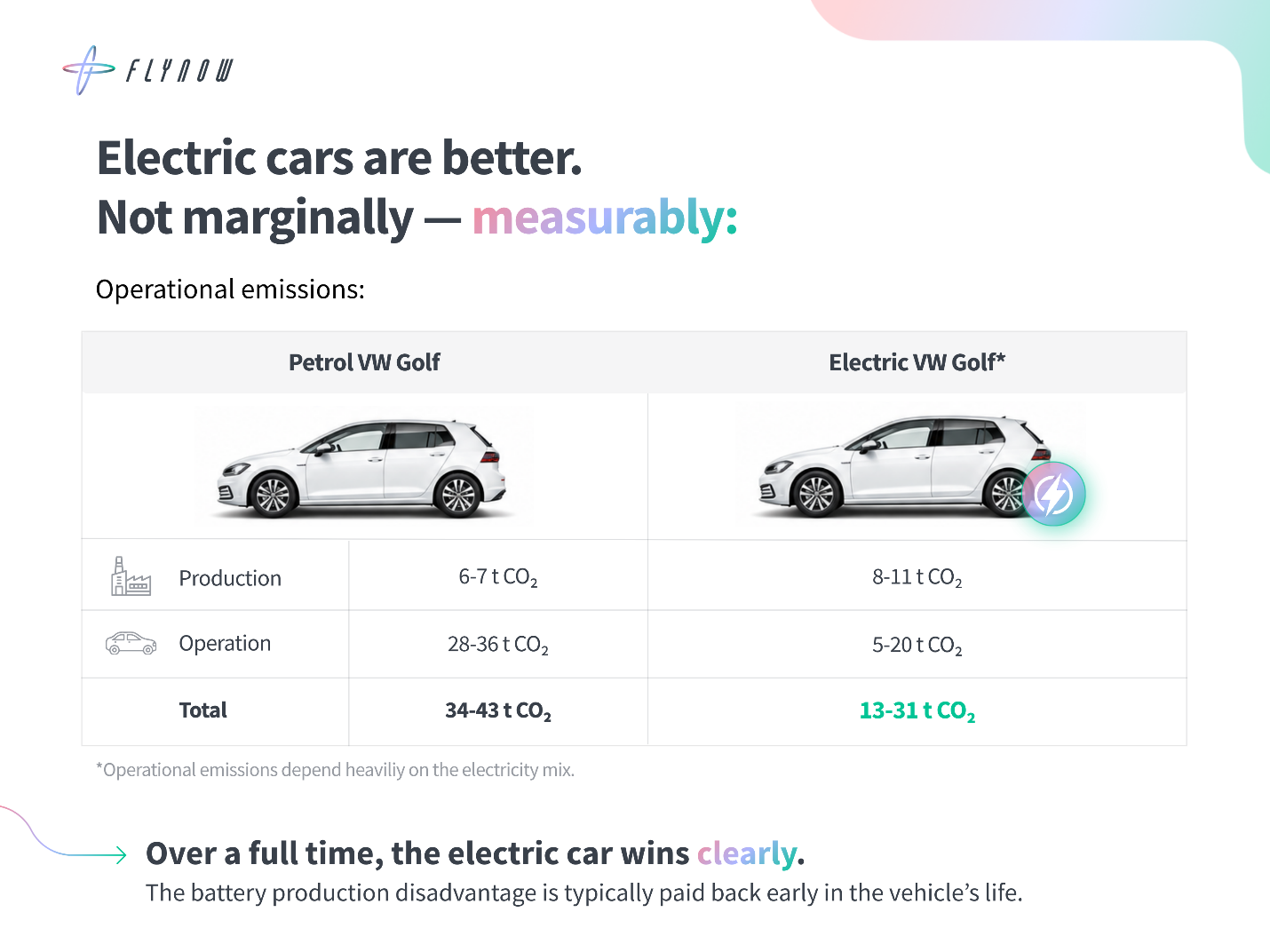
Electric cars are better. Not marginally — measurably.
| Life cycle | Petrol VW Golf | Electric VW Golf* |
|---|---|---|
| Production | 6–7 t CO₂ | 8–11 t CO₂ |
| Operation | 28–36 t CO₂ | 5–20 t CO₂ |
| Total | 34–43 t CO₂ | 13–31 t CO₂ |
*Operational emissions depend heavily on the electricity mix.
The electric Golf begins life with a 2–4-ton CO₂ disadvantage from battery production. It pays that back somewhere between 20,000 and 80,000 km. The ICCT's 2025 European lifecycle study puts the payback nearer 17,000 km — offset inside the first year or two of ordinary driving.
Over a full life, the electric car wins clearly. Anyone telling you otherwise is selling something.
02So why are we still not satisfied?
Because of what we built.
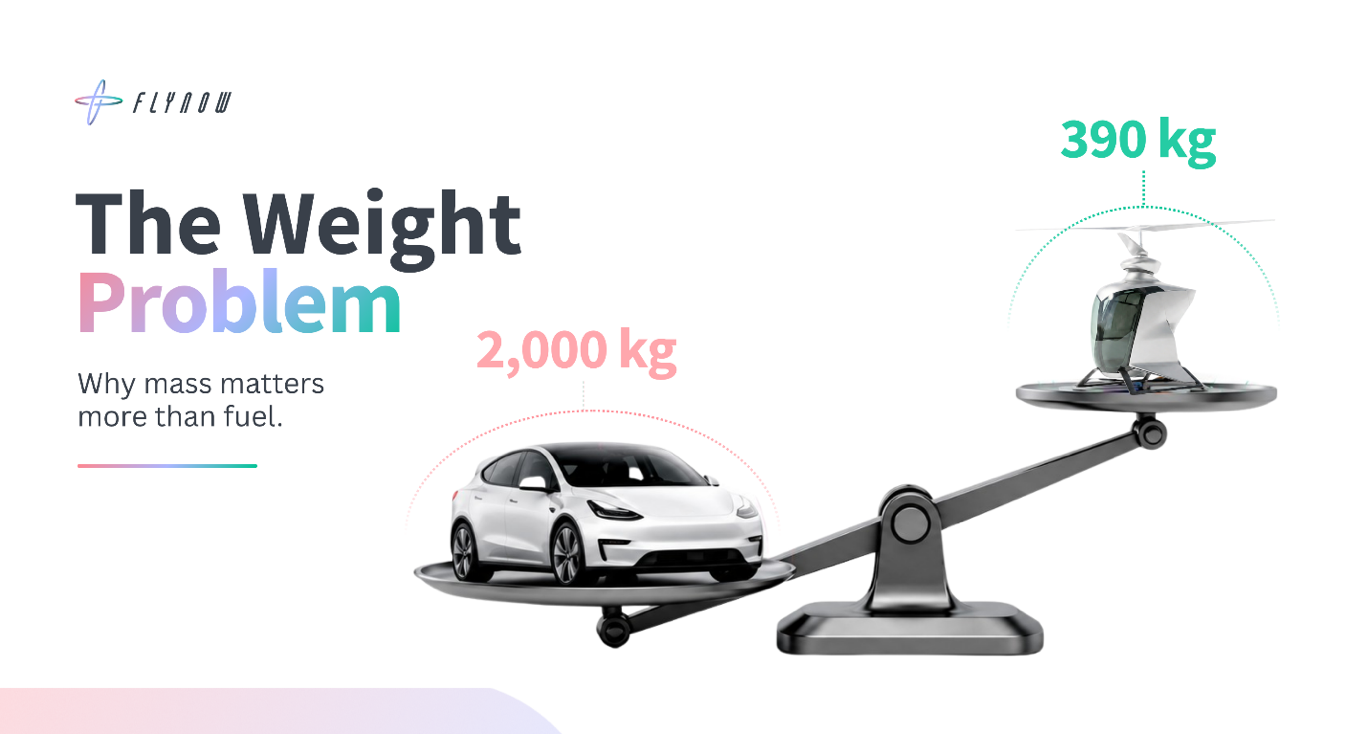
A battery electric car weighs about 2,000 kg. Steel, aluminum, copper, lithium, nickel, rare earths. Its useful job is to carry roughly 200 kg — two people and their belongings.
We spent fifteen years and hundreds of billions changing what powers that machine. We changed the fuel. We never changed the ratio.
03The battery is a symptom and not the disease
This is where the debate goes wrong in both directions.
Critics attack lithium. You will have seen the figure: one kilogram of lithium, two thousand liters of water. It is a real number, but it describes saline brine evaporating from ponds (not fresh water drawn from a supply) and published lifecycle assessments find hard-rock extraction can be comparably water-intensive or worse, depending on how you count. The legitimate concern is not the liter total. It is that extraction concentrates in arid regions where it competes with communities and agriculture. That deserves stating accurately rather than dramatically.
Defenders insist the battery is fine and the argument is settled.
Both are debating the wrong object.
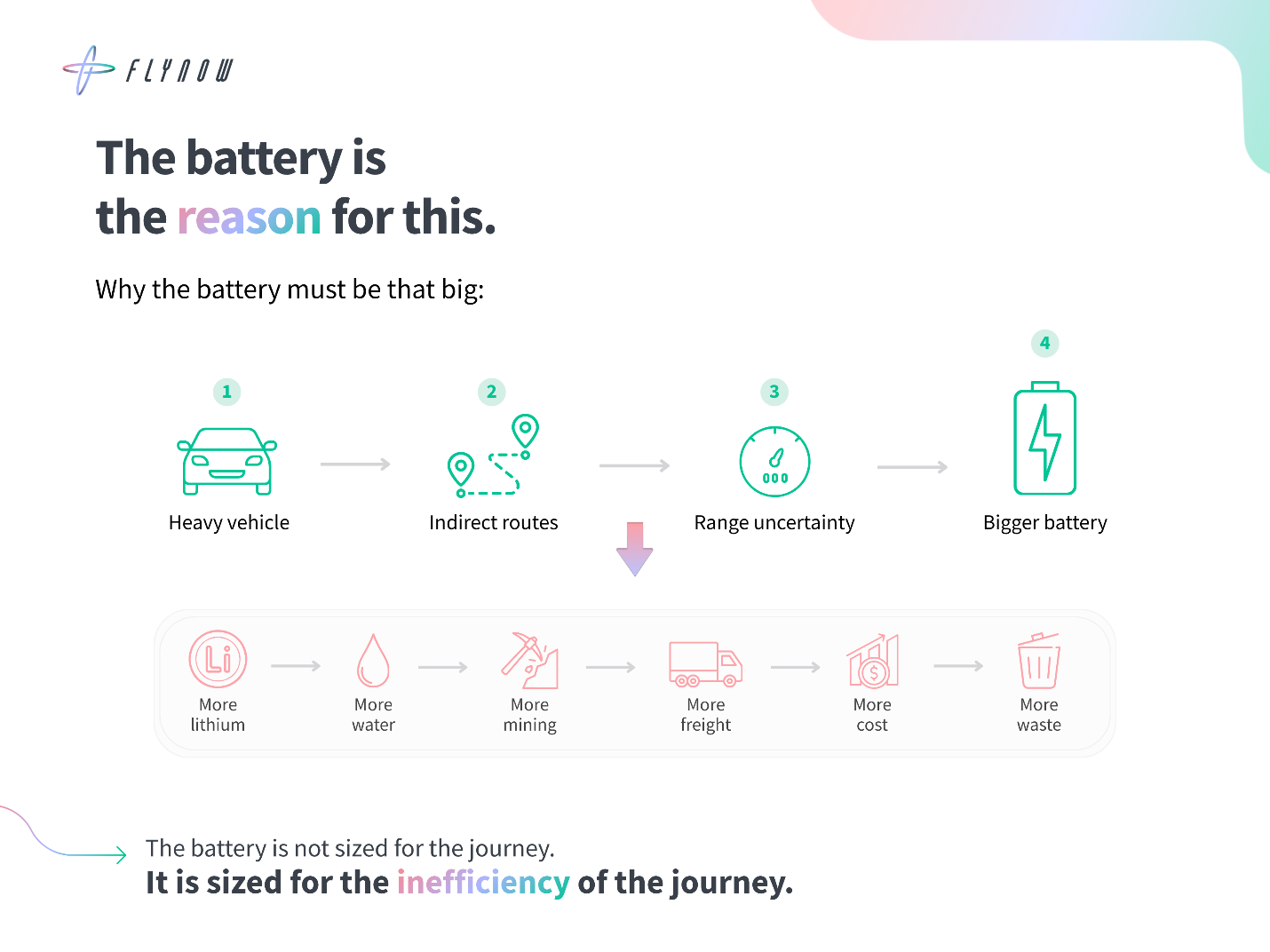
Ask instead why the battery must be that big.
A 60-kWh pack exists because the vehicle weighs two tons, travels indirect routes, and must carry enough range to absorb uncertainty about where it can charge. The battery is not sized for the journey. It is sized for the inefficiency of the journey.
Halve the mass and you halve the battery. Straighten the route and you halve it again. Every kilogram removed takes lithium, water, mining, freight, cost and end-of-life waste with it — and every component that isn't there cannot fail, cannot come from a contested supply chain, and cannot need a spare shipped by sea.
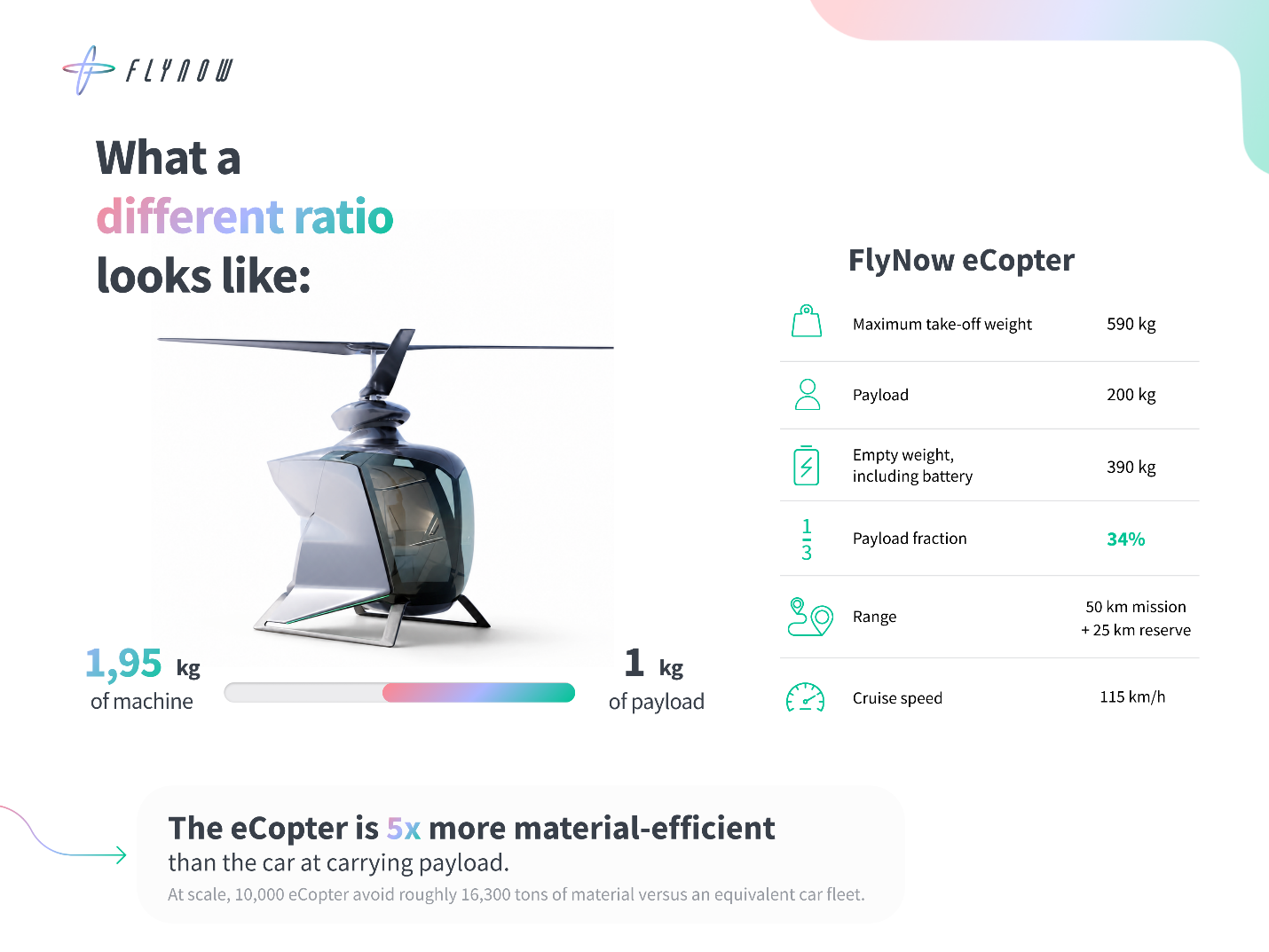
04What a different ratio looks like:
| Maximum take-off mass | 590 kg |
| Payload | 200 kg, at full 50 km range |
| Empty mass, including battery | 390 kg |
| Payload fraction | 34% |
| Range | 50 km mission + 25 km reserve |
| Cruise speed | 115 km/h |
| Recharge | 10 minutes |
| Noise | <55 dB(A) at 150 m (simulated) |
| Operation | Uncrewed, automated |
Now run the car's calculation again on this aircraft.
The eCopter is 5 times more material-efficient at the thing both machines exist to do.
05That is not a marketing comparison. It is the same arithmetic applied twice.
At scale it compounds. Ten thousand eCopters represent roughly 16,300 tons of material never mined, never refined, never shipped and never sent to landfill, relative to the equivalent car fleet.
The number nobody expects us to highlight:
Cruise speed: 115 km/h.
For an aircraft, that is slow. Deliberately.
Speed is expensive in every currency that matters here — energy rises steeply with it, and so does noise, rotor loading and structural mass. The eCopter doesn't need to be fast, because it flies straight. A 50 km separation is 50 km of flying. On the ground, the same separation is 65 to 75 kilometers of road, because roads bend around everything.
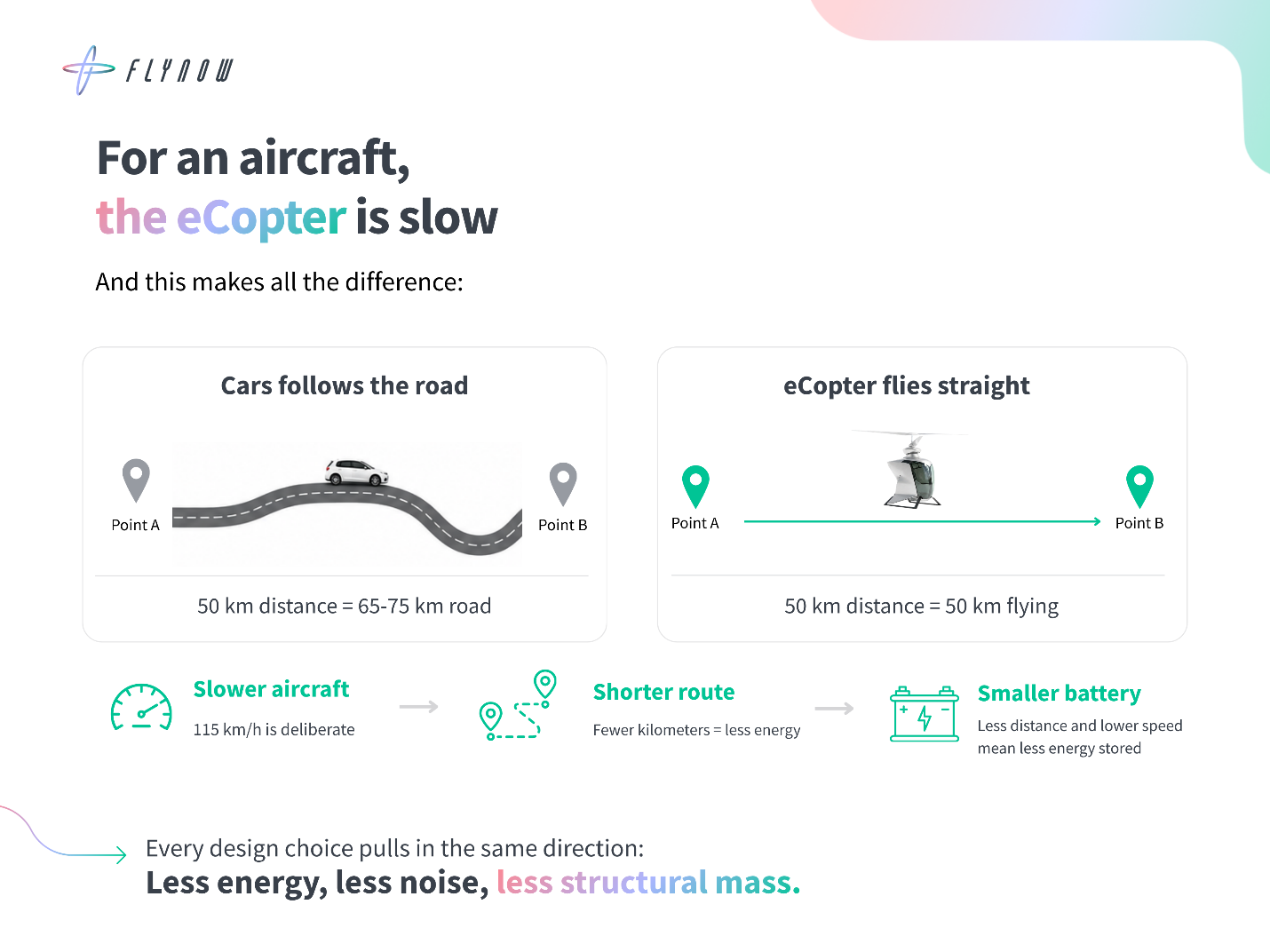
Slower aircraft, shorter route, smaller battery, less material. Every design choice pulls in the same direction.
06And the candid part
Electricity comes from somewhere.
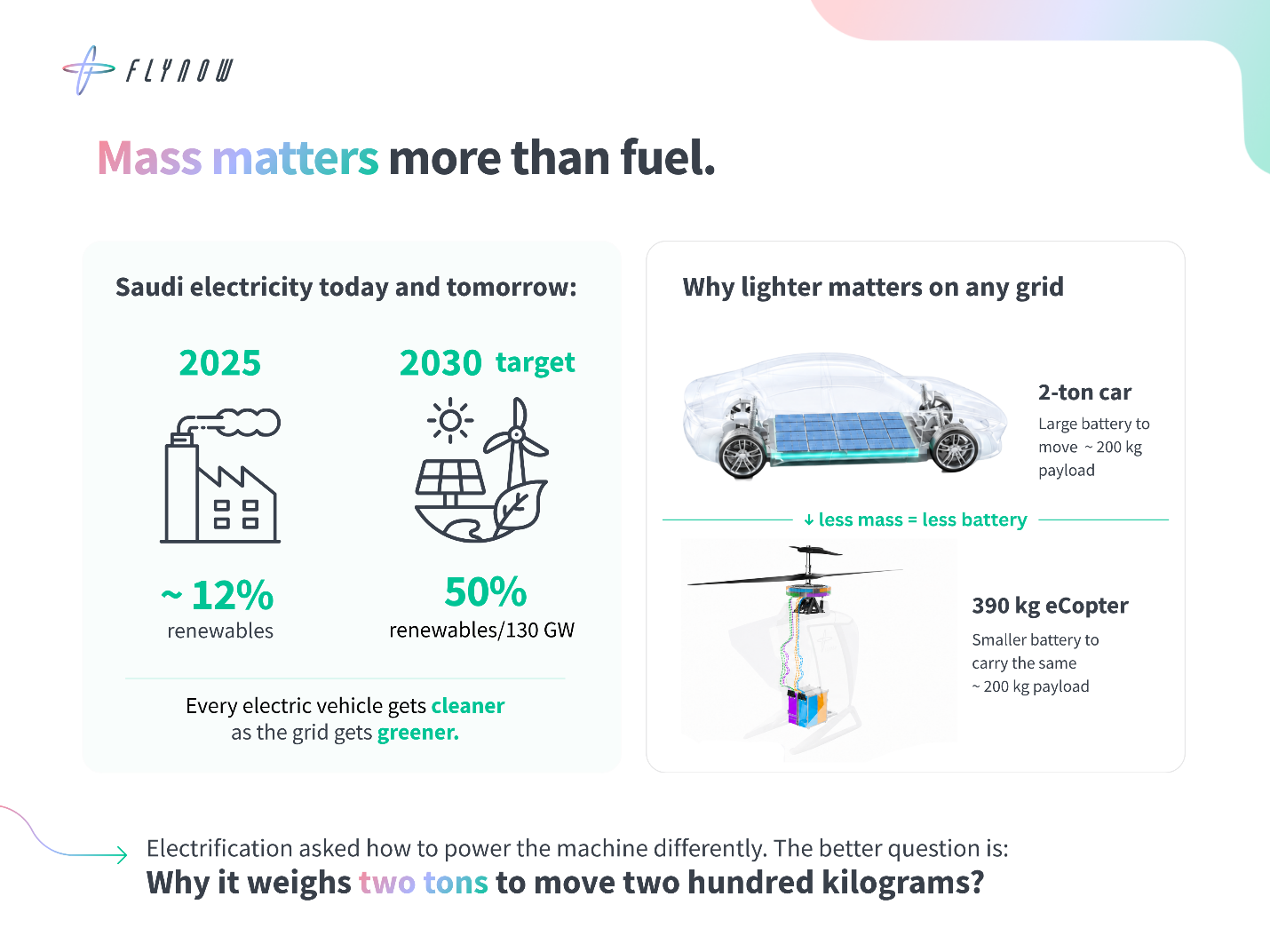
In 2025, renewables supplied roughly 12% of Saudi electricity generation. Charged today in Riyadh, an eCopter runs substantially on gas. We are not going to pretend otherwise.
Two things follow. The Kingdom's stated trajectory is 50% renewables and 130 GW by 2030 — every electric vehicle in the country gets cleaner each year with no change to the vehicle. And this is exactly why mass matters more than fuel: a lighter machine is cleaner on any grid, today, without waiting for the grid to catch up.
There is a harder question underneath, and it's the one we asked ourselves first. A ten-minute recharge is excellent for utilisation — and it means drawing significant power in a short window. Multiply that across a vertiport network and you are no longer discussing aircraft. You are discussing grid peaks, local storage and when that power is cheapest and cleanest to take.
We don't think that's a reason to slow down. We think it's the next problem, and it should be designed for now rather than discovered later.
Electrification asked how to power the machine differently.
The better question is why it weighs two tons to move two hundred kilograms.