Scaling Future with Innovation
5. 10 Global AAM Roadmaps. One Clear Message: The Future Will Be Won by the Ecosystem, not Just the Aircraft.
Yvonne Winter · CEO, FlyNow
Download PDF
01From eVTOL technology to the integrated AAM system and infrastructure layer
The next revolution in mobility will not be won by the best aircraft alone. It will be won by the ecosystem that makes thousands of aircraft operate safely, autonomously and economically as one integrated system.
Let me give you an overview about several reports that shaped the AAM industry during the 2019–2022 hype cycle:
| Organization | Report / Topic |
|---|---|
| McKinsey | AAM / Future of Air Mobility |
| Roland Berger | Urban Air Mobility – The Rise of a New Mode of Transportation |
| Morgan Stanley | eVTOL / Urban Air Mobility |
| Deloitte | Advanced Air Mobility |
| KPMG | Aviation 2030 – AAM Revolution |
| L.E.K. Consulting | AAM cost economics |
| PwC | Urban Air Mobility / AAM |
| ARUP | AAM / Urban Air Mobility infrastructure |
| Uber Elevate | Fast-Forwarding to a Future of On-Demand Urban Air Transportation |
What were the key findings mainly in terms of financial summaries:
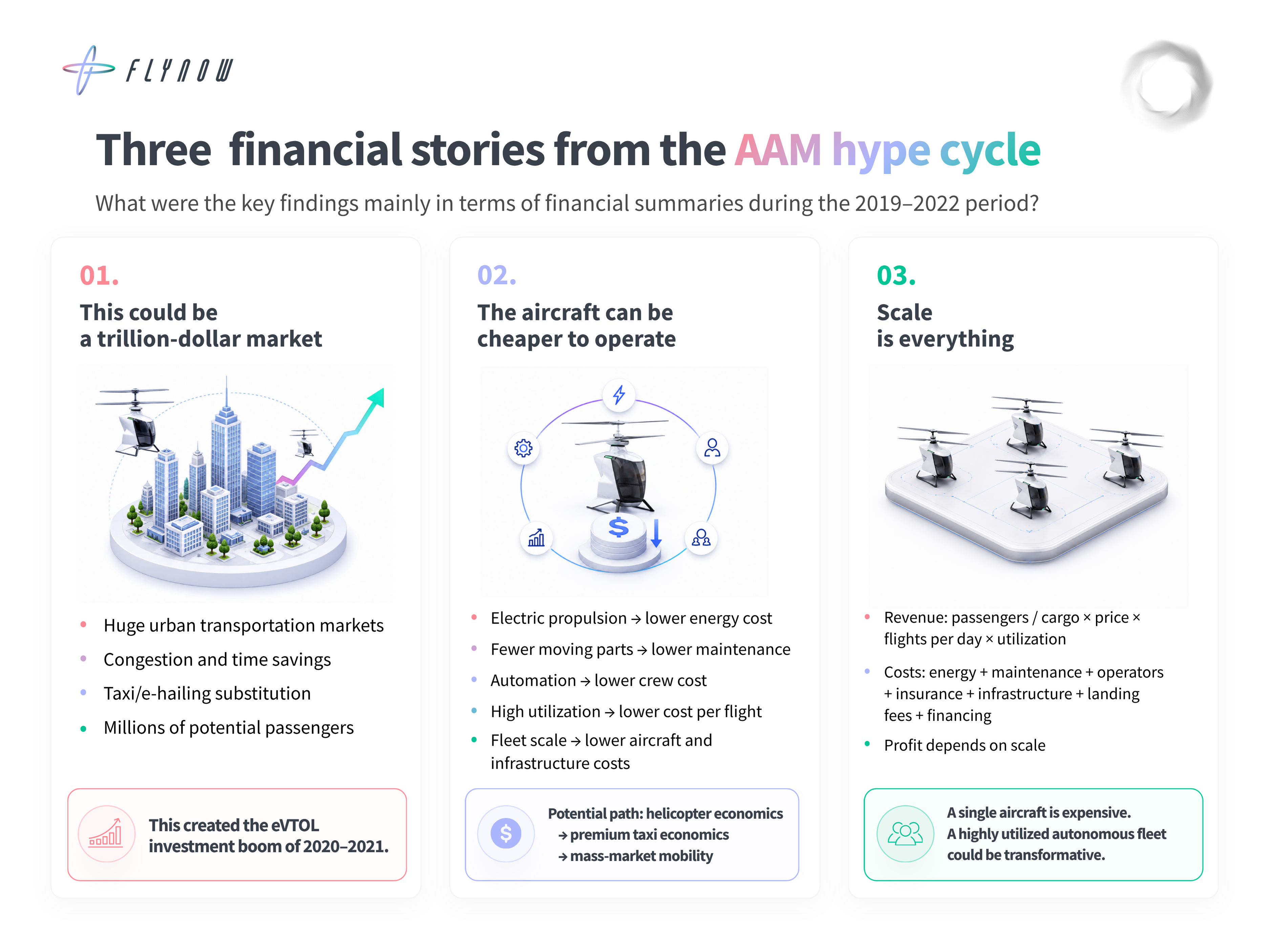
The reports actually tell three different financial stories, depending on when they were written.
1. The early thesis: "This could be a trillion-dollar market."
The early reports from Uber, Morgan Stanley, Roland Berger and others focused heavily on:
- huge urban transportation markets
- congestion
- time savings
- taxi/e-hailing substitution
- millions of potential passengers
- enormous long-term TAM
This created the eVTOL investment boom of 2020–2021.
2. The second thesis: "The aircraft can be cheaper to operate."
Deloitte, KPMG and L.E.K. put much more emphasis on the actual economics.
The potential advantages are:
- Electric propulsion → lower energy cost
- Fewer moving parts → lower maintenance
- Automation → lower crew cost
- High utilization → lower cost per flight
- Fleet scale → lower aircraft and infrastructure costs
- This creates the potential to move from:
- Helicopter economics
toward:
Premium taxi economics, and eventually, potentially:
Mass-market mobility economics.
Deloitte's numbers illustrate this well: eVTOL aircraft potentially cost roughly $1.2–4m, while operational costs can improve significantly versus helicopters.
3. The current thesis: "Scale is everything."
This is where the newer reports are much more realistic.
The fundamental equation becomes:
Revenue: Passengers / cargo × price × flights per day × utilization
minus
Operating costs: Energy + maintenance + pilots/operators + insurance + infrastructure + landing fees + financing
= EBITDA / operating profit
And almost every variable depends on scale, a single aircraft is expensive, a fleet is potentially efficient.
A highly utilized autonomous fleet could be transformative.
That is why Deloitte explicitly argues that competitive pricing requires fleets operating at maximum utilization, not one or two aircraft.
Now we are coming to the TOP 10 Roadmaps and here the finding is:
The industry is gradually moving from an "aircraft race" to a "system integration race."
- GACA — Saudi AAM Roadmap
- WEF — Deployment Pathways for AAM in Saudi Arabia
- WEF — Advanced Air Mobility: Shaping the Future of Aviation
- FAA — AAM Implementation Plan / Innovate28
- FAA/NASA — UAM Concept of Operations 2.0
- EASA — Innovative Air Mobility Roadmap
- Roland Berger + DLR — Unit Economics of AAM
- Deloitte — Scaling Advanced Air Mobility
- NASA — AAM technical/operational research
- KPMG — Advanced Air Mobility Revolution
02The bigger picture
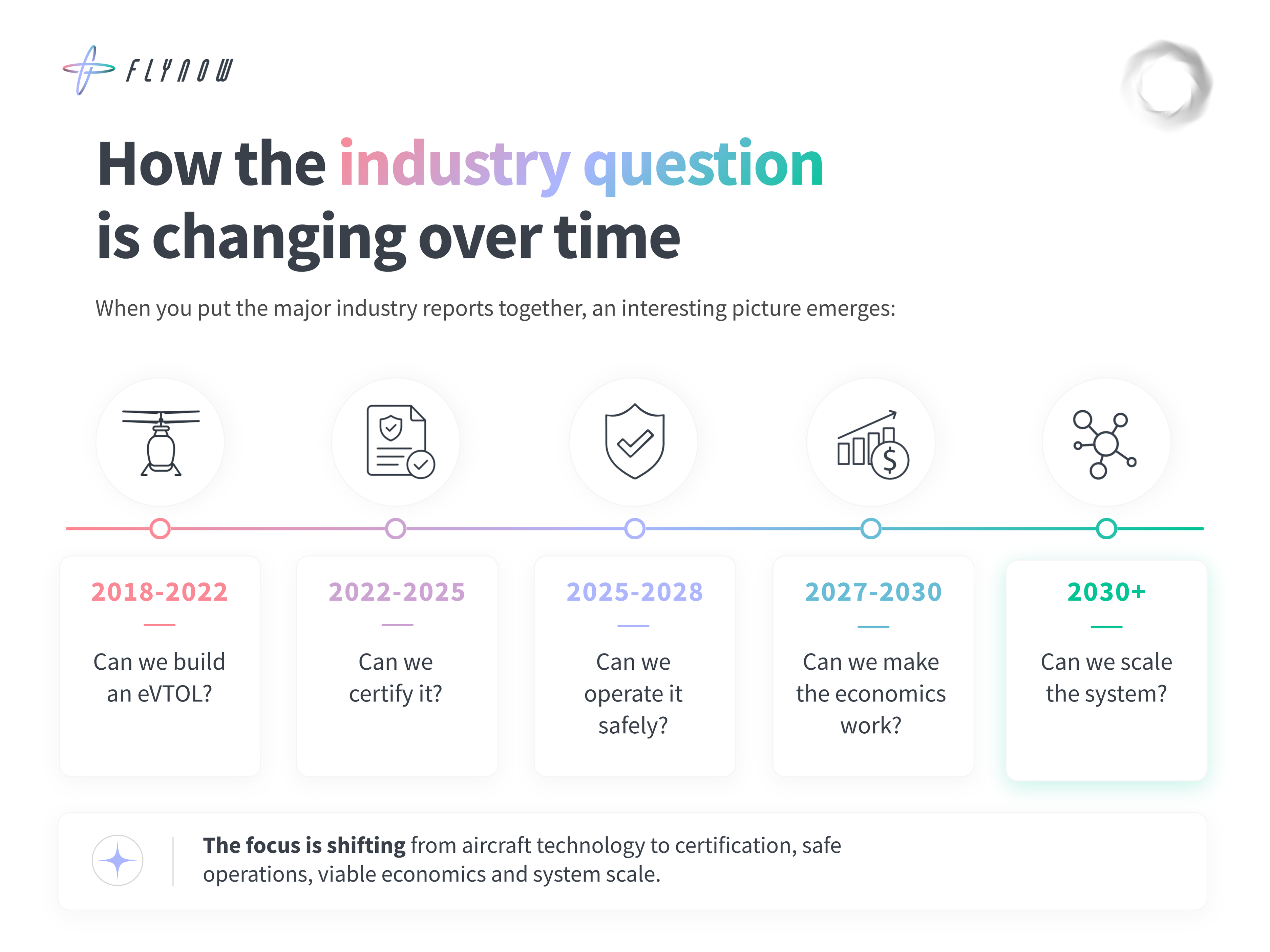
When you put all ten reports together, an interesting picture emerges:
| Phase | Industry question |
|---|---|
| 2018–2022 | Can we build an eVTOL? |
| 2022–2025 | Can we certify it? |
| 2025–2028 | Can we operate it safely? |
| 2027–2030 | Can we make the economics work? |
| 2030+ | Can we scale the system? |
03The Common Findings Across the 10 Leading AAM & eVTOL Reports:
After reviewing the major AAM roadmaps and reports from GACA, World Economic Forum, FAA, NASA, EASA, Roland Berger, Deloitte and KPMG, one thing becomes very clear:
Despite different geographic perspectives and different priorities, there is a remarkable level of convergence around what is required to make Advanced Air Mobility a reality.
The common message is:
AAM is not an aircraft revolution. It is a system revolution.
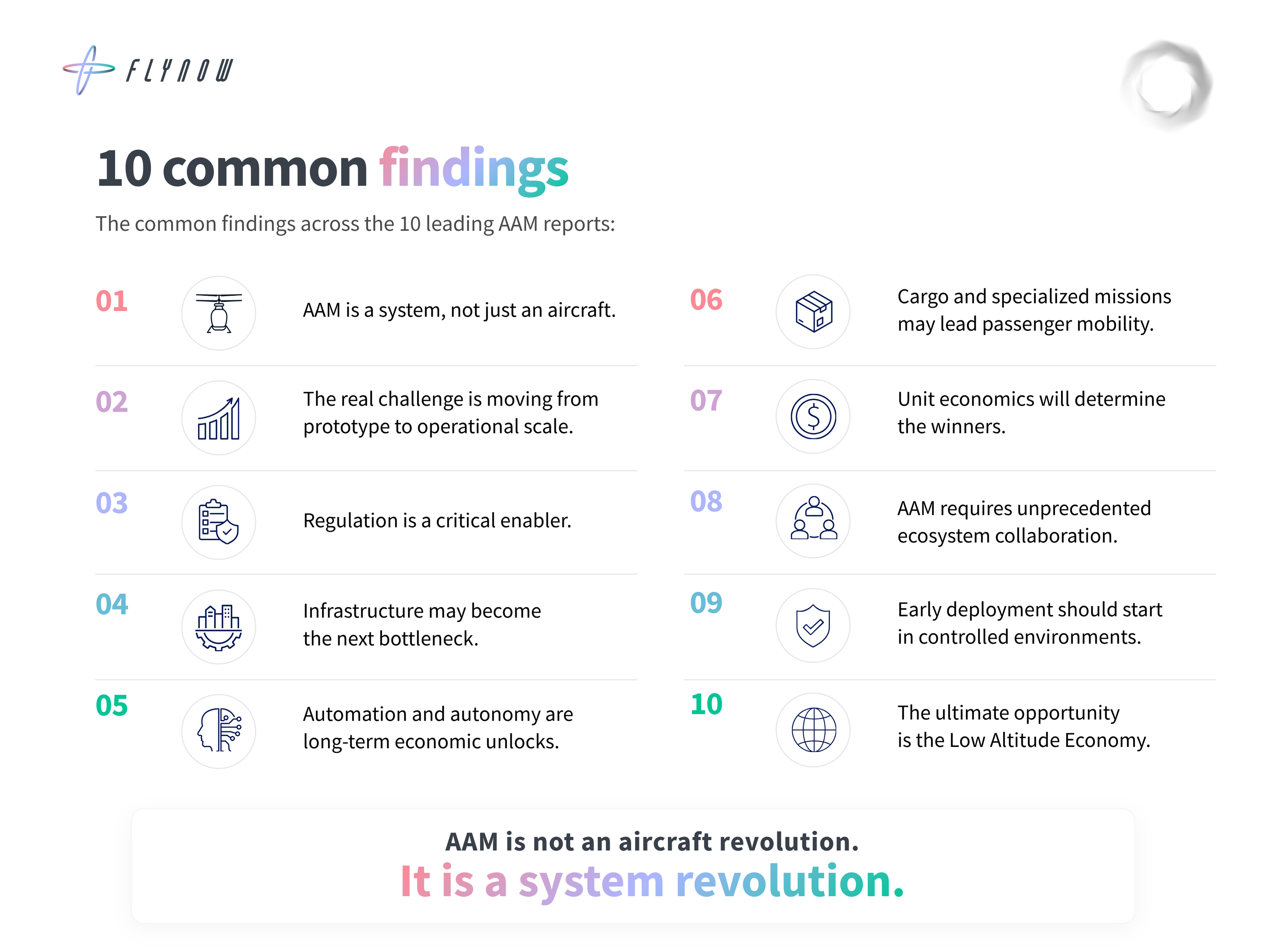
1. AAM is not an aircraft business — it is a system
The eVTOL aircraft is only one element of a much larger ecosystem.
Key takeaway: The winners will not necessarily be those who build the best aircraft, but those who can integrate the complete system.
2. The biggest challenge is moving from prototype to operational scale
Demonstrating that an aircraft can fly is only the beginning.
Commercial AAM requires the ability to operate thousands of aircrafts
Key takeaway: The real milestone is not the first flight. It is repeatable, safe, reliable and scalable operations.
3. Regulation is a critical enabler
Certification of the aircraft alone is not sufficient.
Key takeaway: Regulators, industry and infrastructure providers need to develop the operating environment together rather than sequentially.
4. Infrastructure could become the next bottleneck
The industry often talks about vertiports, but the infrastructure challenge is much broader.
Key takeaway: The aircraft could be ready before the infrastructure ecosystem is ready to support it.
5. Automation and autonomy are the long-term economic unlock
Most roadmaps see AAM evolving through increasing levels of automation:
Piloted → Highly automated → Remotely supervised → Increasingly autonomous
Key takeaway: Autonomy and/or automation is not only a technology opportunity. It is potentially one of the most important economic enablers of AAM at scale.
6. Cargo and specialized missions may lead passenger mobility
Passenger air taxis receive most of the public attention, but many reports identify other use cases as potentially attractive early markets.
Key takeaway: AAM may not start with "flying taxis for everyone." It may start with high-value missions where aviation creates an immediate economic or societal benefit.
7. Unit economics will determine the winners
Early AAM discussions focused heavily on enormous future market forecasts.
The more mature reports increasingly focus on a much more fundamental question:
Can the operation actually make money?
Key takeaway: A huge addressable market does not create a viable business. Operational economics do.
8. AAM requires unprecedented ecosystem collaboration
No single company can build the complete AAM ecosystem.
Key takeaway: AAM will be an ecosystem game, not a single-company game.
9. Early deployment should happen in controlled environments
Most roadmaps recognize that AAM should not immediately attempt to solve the most complex urban environments but rather early opartions like Medical routes.
Key takeaway: Controlled deployment environments can accelerate learning, certification, operational experience and public acceptance.
10. The ultimate opportunity is the Low Altitude Economy
Perhaps the most important common conclusion is that AAM should not ultimately be defined as: "Flying taxis replacing cars."
The opportunity is significantly broader. The emerging Low Altitude Economy can combine: Mobility, Automated systems, Infrastructure, Airspace, Critical services,…
Key takeaway: AAM is potentially the creation of an entirely new economic layer between ground transportation and traditional aviation.
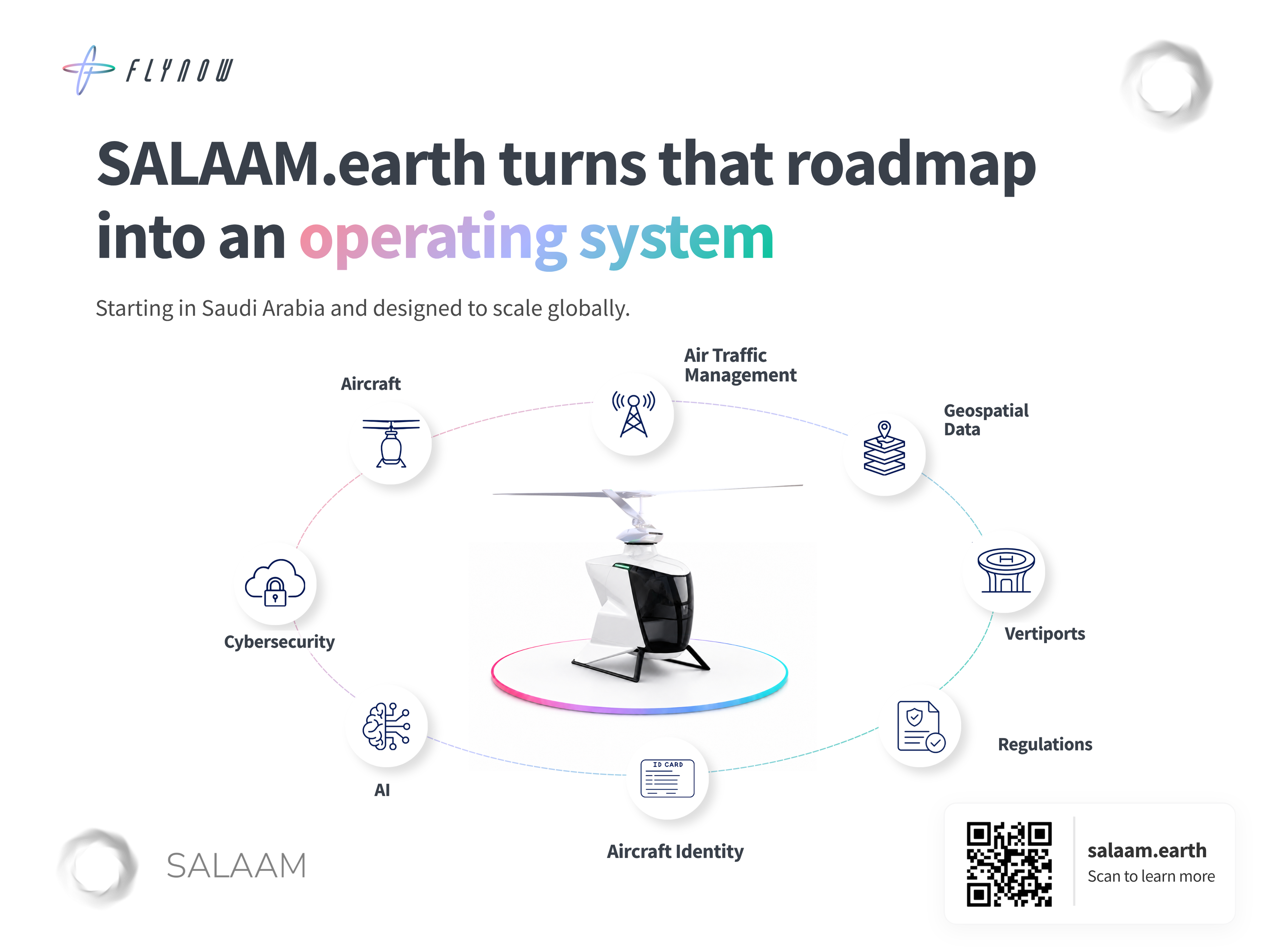
In short: the reports define the challenge; SALAAM.earth turns that roadmap into an operating system for the Low Altitude Economy—starting in Saudi Arabia and designed to scale globally.